

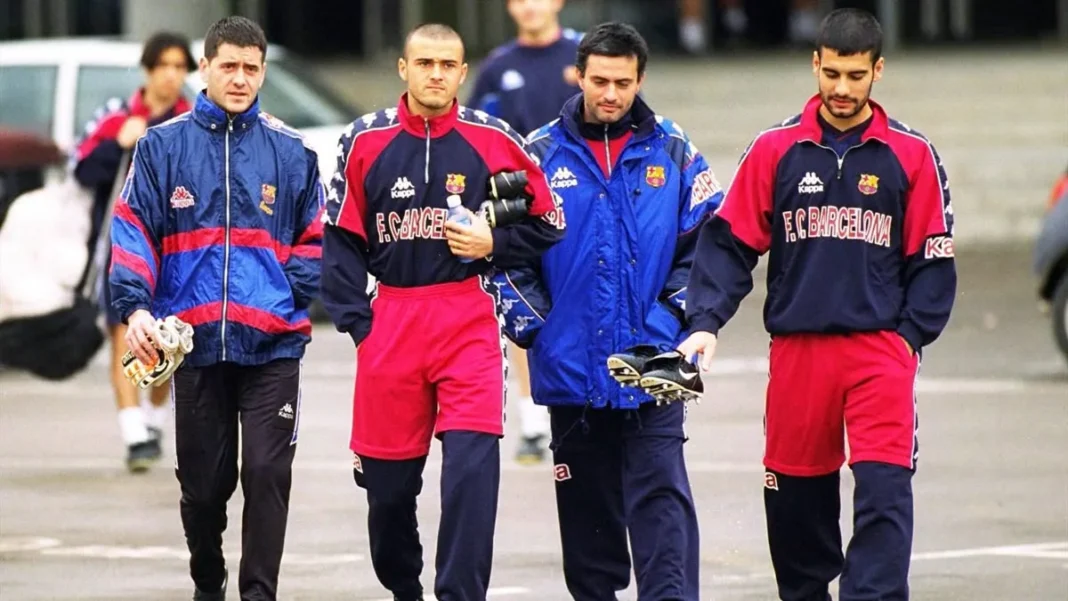

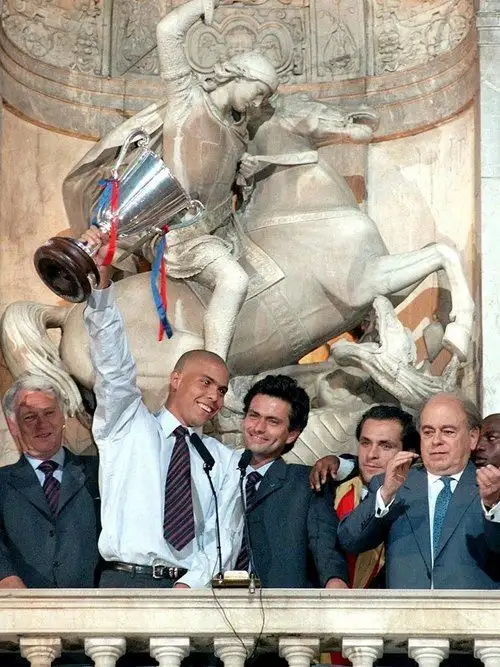
When people think of José Mourinho, they picture the charismatic, headline-grabbing manager who conquered Europe with Porto and Inter. But before the trophies and touchline theatrics, Mourinho was quietly building his reputation at FC Barcelona. When people think of José Mourinho, they picture the charismatic, headline-grabbing manager who conquered Europe with Porto and Inter. But before the trophies and touchline theatrics, Mourinho was quietly building his reputation at FC Barcelona during the 1998–99 season, a campaign that would prove formative in shaping one of football’s most analytical minds.
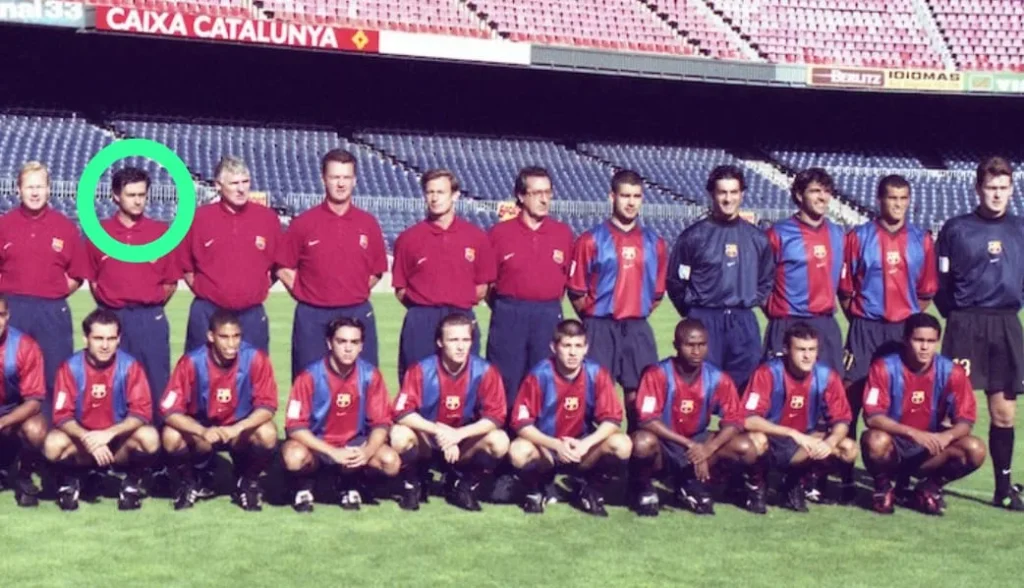
When XAVI, PEP, ENRIQUE played under MOURINHO
At the Camp Nou, he immersed himself in elite-level preparation, studying tactical structures and learning how top clubs operate from the inside. Working closely with senior players and absorbing the methodologies around him, Mourinho refined his understanding of positional play, squad management, and psychological control. It was here that his obsession with detail truly intensified every opponent analyzed, every scenario rehearsed. Long before he became “The Special One,” he was mastering the craft in silence, laying the intellectual foundations for a career that would later redefine modern coaching.
A Trusted Lieutenant Under Louis van Gaal
During the 1998–99 season, FC Barcelona were managed by Louis van Gaal, a disciplinarian and tactician known for structural precision and strict positional play. Mourinho served as part of Van Gaal’s coaching staff, operating in a hybrid role that blended assistant coaching with advanced tactical analysis.
Though not yet a head coach, Mourinho’s influence ran deeper than many realized. He was far more than a translator, a misconception that followed him early in his career. By this stage, he was already heavily involved in:
- Designing and structuring training sessions
- Breaking down opposition tactics through detailed scouting
- Delivering analytical briefings to players
- Translating tactical ideas into practical on-pitch drills
Van Gaal valued clarity and preparation. Mourinho delivered both.
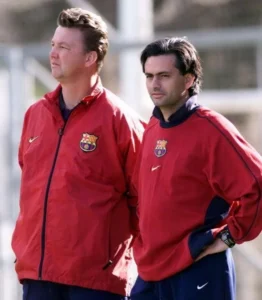
Beyond the whiteboard, Mourinho became a bridge between ideology and execution. Van Gaal’s philosophy demanded strict spacing, intelligent movement, and tactical discipline; Mourinho ensured those principles were absorbed and internalized by the squad. He often led video analysis sessions, pausing clips to highlight subtle positional errors or pressing triggers that could change a match’s rhythm.
He also developed a reputation for scenario-based preparation. If Barcelona were facing a team strong in counterattacks, training would simulate defensive transitions repeatedly until reactions became instinctive. If the opponent relied on aerial dominance, set-piece rehearsals intensified. Nothing was left to improvisation.
Perhaps most importantly, Mourinho began sharpening the psychological edge that would later define his managerial career. He understood that tactical clarity builds confidence and confident players execute plans with conviction. Even in a supporting role, he was already shaping the competitive mindset of an elite dressing room.
Master of Preparation
The 1998–99 FC Barcelona side was stacked with talent Rivaldo, Luís Figo, Patrick Kluivert, and Pep Guardiola were central figures. Managing elite personalities required not just authority, but preparation. In a dressing room filled with Ballon d’Or contenders and strong characters, credibility came from knowledge. Mourinho understood that players of that calibre would only fully buy into ideas that were meticulously thought through and clearly justified.
Mourinho became known internally for his exhaustive reports. Opposition teams were dissected in microscopic detail: defensive transitions, pressing triggers, build-up patterns, set-piece routines, and even subtle behavioural tendencies under pressure. Long before data analytics became mainstream in football, Mourinho embraced structured analysis as a competitive advantage. He believed that information, when properly filtered and delivered, removed doubt and created conviction.
Training sessions reflected this philosophy. Practices were not random drills but scenario-based rehearsals designed to simulate real match conditions. If Barcelona were to face a deep defensive block, Mourinho ensured the squad repeatedly rehearsed breaking compact lines through third-man runs and positional rotations. If the opponent pressed high, the team trained specific escape patterns, rehearsing angles and passing sequences until they became automatic.
He placed particular emphasis on transitional moments the few seconds after losing or winning possession, recognizing that modern matches were often decided in chaos rather than control. Every possible situation was anticipated. Every weakness was stress-tested. Preparation reduced uncertainty and uncertainty loses matches.
Tactical Intelligence and Communication
One of Mourinho’s greatest strengths was communication. He didn’t merely collect information; he translated complex tactical frameworks into clear, actionable instructions. Under Louis van Gaal’s positional system, spacing and discipline were non-negotiable. Mourinho acted as the conduit between theory and execution, ensuring players understood not just what to do, but why they were doing it.
He was known for breaking down tactical meetings into digestible segments, reinforcing key ideas with video clips and practical demonstrations. His delivery was calm yet authoritative, detailed yet accessible. Players responded because they felt prepared, not overwhelmed.
This period also allowed Mourinho to observe elite squad management at close quarters:
- How to rotate players effectively across domestic and European competitions
- How to maintain authority in a dressing room filled with global stars
- How to protect team identity during tactical adjustments
- How to balance discipline with motivation over a long campaign
Barcelona would go on to win La Liga that season, reinforcing the effectiveness of their systematic approach. While Van Gaal was the architect, Mourinho was an essential engineer ensuring the blueprint functioned in reality.
Foundations of “The Special One”
While Mourinho would later craft his own pragmatic and defensively resilient identity, elements of his Barcelona education remained visible throughout his managerial career. The DNA of his future triumphs was already forming in those analytical meetings at Camp Nou.
Core principles that carried forward included:
- Obsessive match preparation
- Detailed opponent analysis
- Tactical adaptability
- Psychological awareness
- Strategic control of game tempo
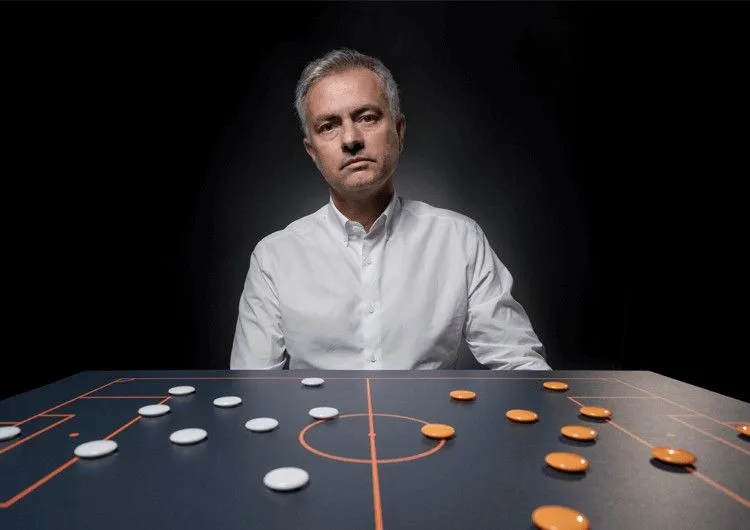
When he later lifted the Champions League with Porto and Inter, observers praised his strategic genius. Yet that genius was not spontaneous; it was cultivated through years of immersion in elite tactical culture.
His later successes with Porto, Chelsea, Inter, and Real Madrid did not emerge in isolation. They were constructed on foundations laid during years of apprenticeship and the 1998–99 Barcelona season was one of the most significant chapters in that development. It refined his discipline, sharpened his analytical mind, and strengthened his belief that preparation beats improvisation.
More Than an Assistant
History often remembers managers for the trophies they lift, not the roles they once played. Yet Mourinho’s time in Catalonia illustrates a crucial truth about elite coaching: greatness is rarely instant. It is assembled piece by piece, lesson by lesson.
At Barcelona, he learned how elite institutions function, how decisions are made, how pressure is managed, how narratives are controlled. He observed how authority must be reinforced daily through competence. He studied how tactical identity can shape culture.
Before he commanded the spotlight, José Mourinho mastered the shadows studying, planning, refining.He built intellectual armour long before he needed it.And in doing so, he quietly prepared himself not just to win matches, but to influence an era of European football.