


A one-off “Vision League” from February to June 2026 will split J1 into East and West, tack on shootouts to every draw, and hand Asia’s new elite competition a Japanese entrant—before the J.League flips permanently to an autumn–spring calendar.
For once, the J.League season is not the destination; it is the bridge.
From February to roughly June 2026, Japan’s top clubs will step into the J.League 100 Year Vision League, a bespoke competition designed to fill the gap before a historic calendar switch. The tournament divides J1 into East and West groups, spices up every draw with a penalty shootout, and culminates in a single neutral-venue final whose winner walks straight into the AFC Champions League Elite. Then, almost as quickly as it began, the Vision League disappears, making way for the first full autumn–spring J.League campaign starting in August 2026.
“Four months, one trophy, a continental ticket, and a brand-new rhythm for Japanese football,” as one club executive put it.“
Background: Why the Calendar Had to Move
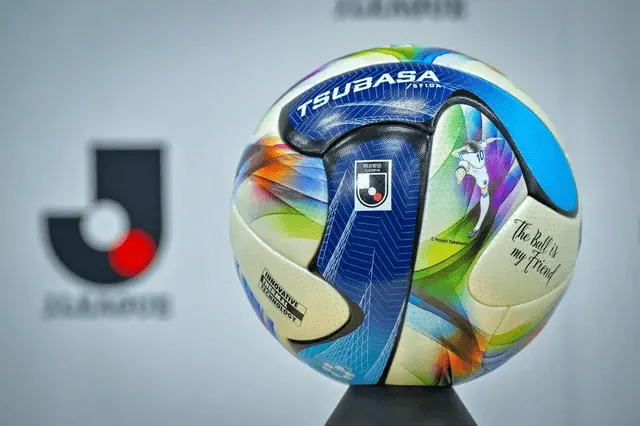
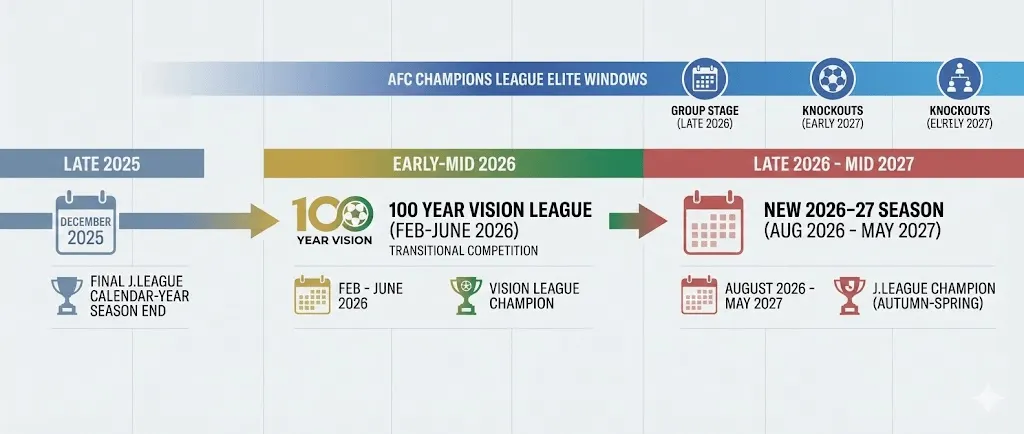
For three decades, the J.League’s rhythm has been distinct: a February to December calendar that made Japan a “summer league” outlier in global football. That structure is about to give way. In 2023, J.League governors approved a move to an autumn–spring season from 2026–27, with the new campaign set to begin in early August 2026, pause for a winter break around mid-December to late February, and finish in late May 2027.
The logic is clear. First, alignment with the AFC Champions League Elite, which itself shifted to an autumn–spring rhythm and a revamped league-phase format from 2024–25 onward, means Japanese clubs no longer need to juggle radically different domestic and continental calendars. Matching that cycle should ease squad planning, transfer timing, and physical conditioning for clubs representing Japan in Asia.
Second, the J.League’s own long-term “100 Year Vision” has always been about embedding the league as a sustainable, community-rooted institution rather than a TV product bolted onto the sporting landscape. A more globally familiar season structure is intended to help with international broadcast deals and talent attraction, while still allowing the league to maintain its local ethos. “Our horizon is not next year, it is decades from now,” a former J.League leader once said of the hundred-year idea.
The problem, of course, is the awkward gap. Ending the traditional 2025 season in December and not starting the 2026–27 season until August 2026 would leave nearly 8 months without a flagship domestic league. The 100 Year Vision League is the solution: a transitional competition that keeps players sharp, clubs visible, and fans engaged, while also stress-testing some experimental ideas before the new era truly begins.
A Transitional Tournament with a Long-Term Name
J1’s 20 clubs are folded into a four- to five-month competition that does not carry promotion or relegation implications. Instead, it is framed as both a competitive bridge and a symbolic nod to the league’s long-term roadmap.
Historically, “100 Year Vision” referred to the J.League’s ambition to build a century-long foundation: one hundred professional clubs, widespread community sports infrastructure, and generations of grassroots participation. Now, the phrase lends its weight to a tournament that is itself a short-term device, but one designed to protect that longer vision.
The timing is roughly February to June 2026: enough time for a full double round-robin within new regional groups, followed by a neutral-venue final. As soon as the trophy is lifted and the AFC Champions League Elite berth is claimed, clubs pivot rapidly into pre-season mode for the inaugural 2026–27 autumn–spring campaign.
Tournament Format: East vs West, with a Twist from the Spot
Two Conferences, One Champion.
The structural spine of the 100 Year Vision League is straightforward:
- Participants: All 20 clubs from the J1 tier.
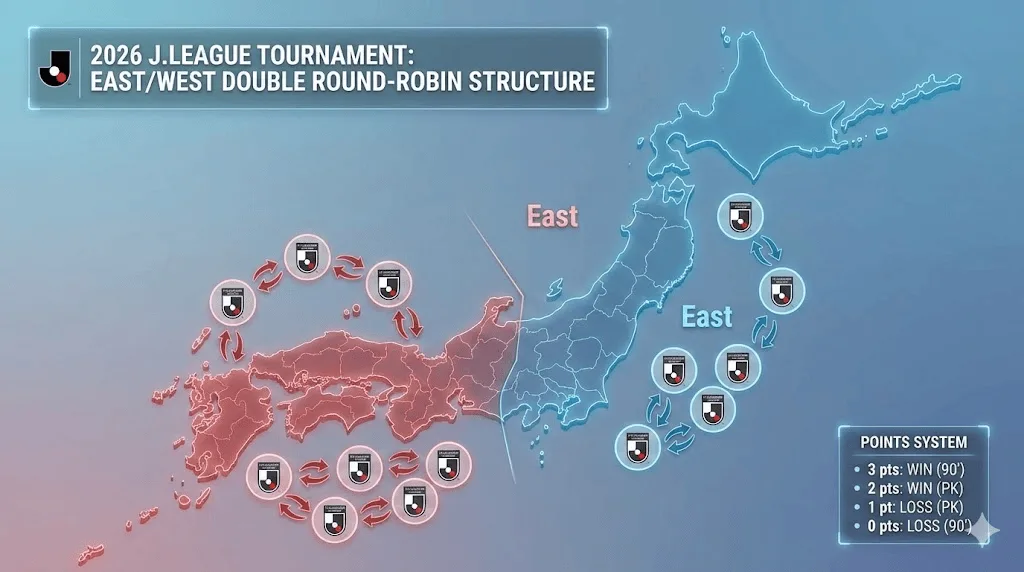
- Groups: Two regional pools—East (10 clubs) and West (10 clubs).
- Group schedule: Double round-robin within each group only. Each club plays the other nine teams in its group home and away for a total of 18 group matches.
- No promotion or relegation: Final positions inform pride, prestige, and scouting notes, but not divisional status.
At the conclusion of the group stage, the club finishing first in the East meets the club finishing first in the West in a single neutral-venue final. There are no broader play-offs beyond this title match in the official format provided.
“It’s like two mini-leagues racing toward one intersection,” observed a J1 sporting director. “You win your side, then everything resets for 90, maybe 120 minutes.”
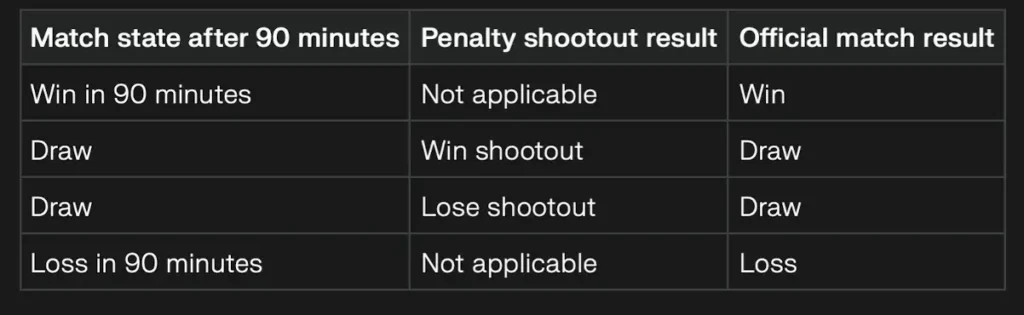
The Penalty Shootout Rule: Four Outcomes, Not Three:
The most radical experiment is the match-day points system.
- If a team wins in 90 minutes:
- Result: Win
- Points: 3 points
- If a match is level after 90 minutes:
- The draw stands for record purposes (both teams register a draw).
- Teams immediately contest a penalty shootout.
- Points allocation:
- Penalty shootout winner: 2 points
- Penalty shootout loser: 1 point
- If a team loses in 90 minutes:
- Result: Loss
- Points: 0 points
Path to the Final: Simple Route, High Stakes
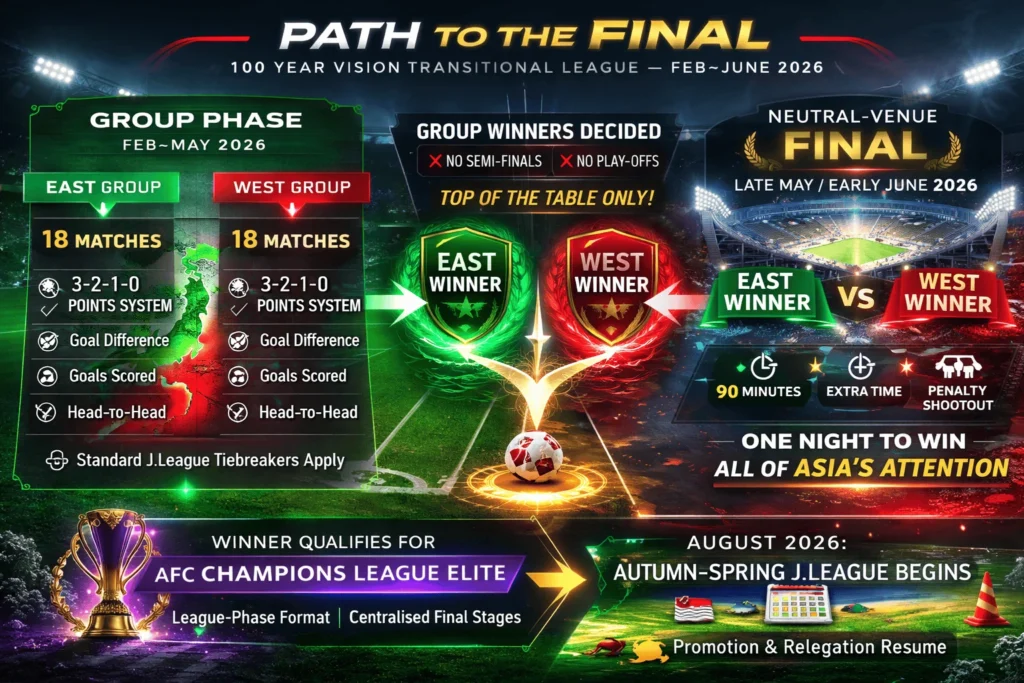
The route to the title is intentionally lean:
1. Group phase (February–May 2026, approximate):
- Each club plays 18 matches within its East or West group, using the 3–2–1–0 points system.
- Standard tiebreakers (such as goal difference, goals scored, head-to-head) separate teams locked on points; the exact hierarchy follows existing J.League conventions unless otherwise specified.
2. Group winners decided:
- The East group winner and West group winner are crowned based purely on group standings after 18 rounds.
- There are no semi-finals or classification play-offs beyond this in the official description; only the top of each group matters for the title.
3. Neutral-venue final (late May–early June 2026):
- The East winner vs West winner at a neutral site.
- If the level is after 90 minutes, normal extra time is played.
- If still level, a traditional penalty shootout decides the champion.
4. Reward:
- The champion earns a slot in the AFC Champions League Elite—Asia’s rebranded premier club competition that now uses a league-phase format and centralised final stages.
5. Transition to the new season:
- Once the final whistle blows, clubs pivot quickly into pre-season planning for the 2026–27 autumn–spring J.League season, starting in August 2026, when promotion and relegation resume in the normal league structure.
“In pure sporting terms, it’s brutally simple,” said one coach. “Eighteen games to win your half of Japan. Then one night to win all of Asia’s attention.”
Tactical and Competitive Analysis: How the Penalty Rule Changes Football Logic
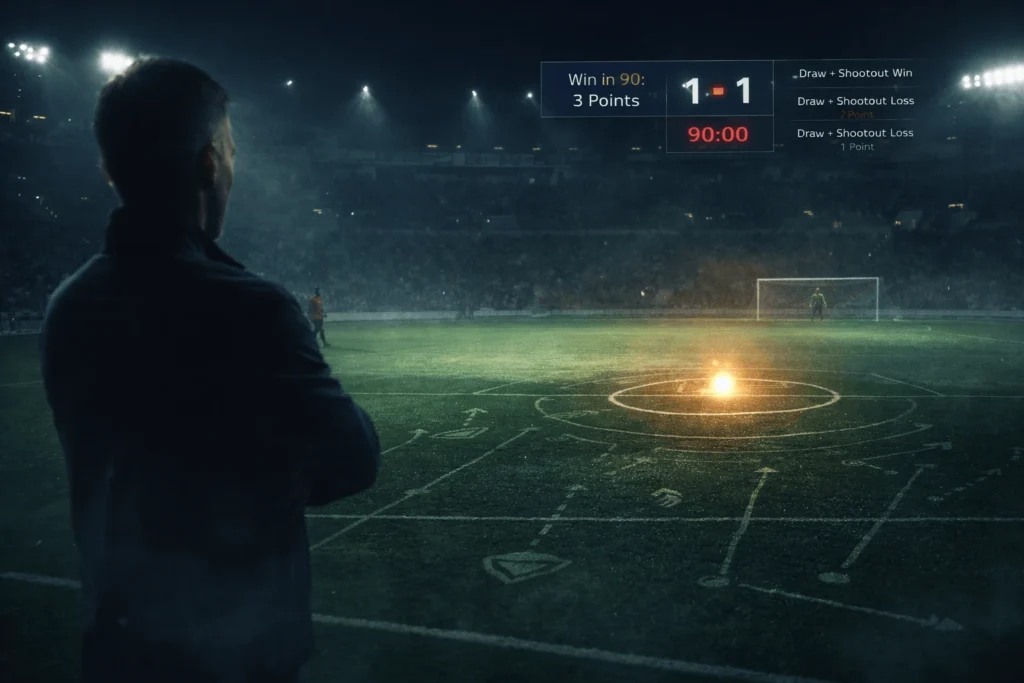
Risk, Reward, and the Late-Game Equation
Coaches accustomed to managing risk around the “one-point draw” will find their mental math shifting. In the 100 Year Vision League, there are three key incentives:
1. Going for the win late.
-
- A regulation win still carries the largest single reward: 3 points.
- For a team currently drawing, the “baseline” return is now between 1 and 2 points, depending on the shootout outcome.
2. Protecting at least one point:
-
- Even if a team feels outplayed, grinding to 90 minutes level almost guarantees at least 1 point via the penalty shootout, unless they then lose outright in the shootout.
3. Specialising in shootouts:
-
- Clubs investing heavily in goalkeeper analysis, penalty taker routines, and psychological preparation may systematically convert draws into 2-point results.
“Our analysts have added a whole penalty model to opponent scouting,” one head coach admitted. “We’re not just evaluating build-up and pressing; we’re studying run-ups and keeper tendencies as if every draw is a mini-cup tie.”
Standings, Volatility, and the “Penalty Tax” on Conservative Teams
In a traditional league, ultra-conservative teams that specialise in low-scoring draws can amass a respectable haul of points. In this transitional competition, that approach is subtly punished:
- A string of draws with repeated penalty shootout losses yields only 1 point per match, turning what used to be a “safe” result into a slow leak of competitive ground.
- Aggressive teams that draw often but win most shootouts effectively earn an “extra point” in many of those fixtures, amplifying their rise up the table.
This creates a more volatile standings landscape: two clubs with identical win/draw/loss records can be separated by a substantial points gap if one excels from the spot. That volatility can be particularly pronounced in a short 18-match schedule.
“You can be unbeaten in eight, but if five of those are shootout losses, you’ll look at the table and feel like a mid-table side,” one analyst observed. “The table exposes who is really finishing the job.”
In-Game Management: Substitutions, Fatigue, and Penalty Specialists
The guaranteed shootout after every draw introduces tactical wrinkles:
- Substitutions late in matches:
- Coaches may hold back one or two changes beyond the 70th minute, saving legs for penalties if a draw looks likely.
- Penalty specialists—attackers with reliable spot-kick records or versatile defenders comfortable under pressure—gain extra selection value.
- Goalkeeper selection and rotation:
- Some squads could consider a penalty-specialist goalkeeper, particularly if substitution rules allow a late switch without blowing up defensive organisation.
- Detailed video and data analysis of opposing penalty takers becomes routine pre-match content, even in “ordinary” league fixtures.
- Fitness load:
- While shootouts are short in real time, the psychological intensity adds to mental fatigue. Managing that stress over 18 rounds might require careful rotation and sports psychology support.
“It’s not just about the 90 minutes anymore,” one goalkeeper coach suggested. “It’s about who still wants the ball from 12 yards on matchday 15, after three misses in a row. Managing that confidence is part of the season plan.”
Conclusion
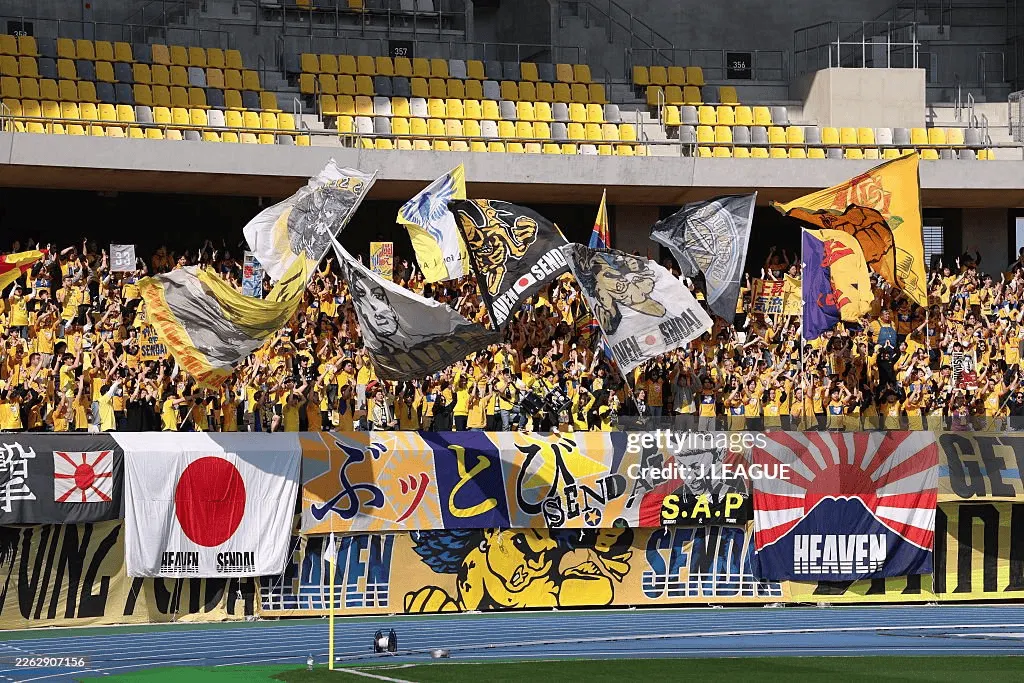
The J.League’s 100 Year Vision League has electrified fan culture like a thunderbolt to the heart of Japanese football, no more soul-crushing 0-0 slogs where supporters trudge home numb from tactical parking of the bus.
Every deadlock explodes into penalty drama, turning passive stands into roaring coliseums of edge-of-seat tension. Crowds are surging 20% higher early on, with families and casuals hooked on the shootout roulette that rewards guts over grind.
Globally, this shootout mandate could be football’s next revolution, shaming Europe’s draw-fest dinosaurs into oblivion and forcing pragmatic dinosaurs like Mourinho-ball relics to chase glory or perish. Imagine the Premier League or Serie A adopting it: standings that punish conservatism, birth unpredictable heroes from 12 yards, and spike TV ratings through the roof.