



There’s a word people keep using when they talk about Bodø/Glimt. Dark horse. Like they’re some kind of pleasant accident, a team that keeps showing up and surprising everyone before eventually going home.
But here’s the thing about dark horses. They surprise you once, maybe twice, and then you stop being surprised. What Bodø/Glimt are doing right now is something else entirely.
They’ve beaten Manchester City. They’ve gone to the Wanda Metropolitano and beaten Atletico Madrid. They’ve dismantled Inter Milan, last season’s UCL finalists, 5-2 on aggregate, 3-1 at home and 2-1 at San Siro. And now they’ve put three past Sporting CP in the first leg of the Round of 16, with one foot already in the quarter-finals.
At some point, you stop calling it an upset. This is a pattern.
Who are Bodø/Glimt and where do they come from?
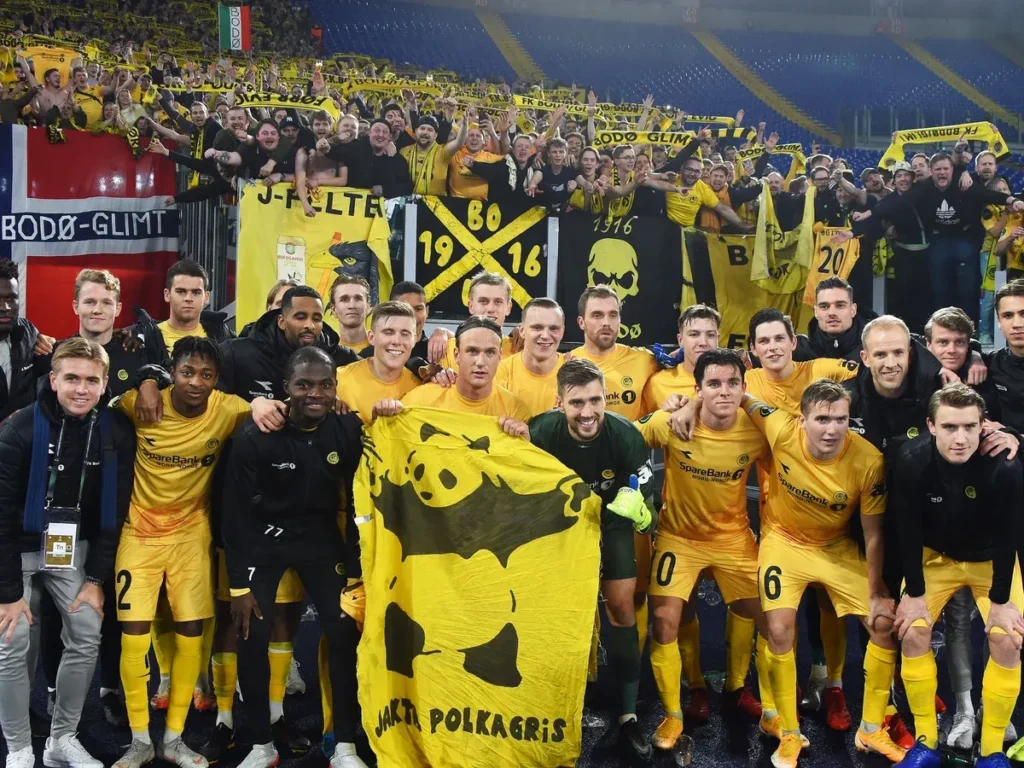
Bodø/Glimt are from the Arctic region of Norway. One of the coldest places in the world. Their stadium holds 8,000 people. Their pitch is artificial turf because real grass simply cannot survive up there.
They were promoted to the top flight in 2017. Within three years, they were Norwegian champions. They’ve won four Eliteserien titles since 2020, and last season they became the first Norwegian club to reach a European semi-final in 30 years, knocking out Lazio in the Europa League quarters before being eliminated at the semis.
This isn’t a team that stumbled into success. There’s been a clear, deliberate build.
The Knutsen Philosophy

Manager Kjetil Knutsen joined in 2018 and has never really left the club’s identity alone since. What he built isn’t complicated to explain, it’s just hard to defend against. High press, quick transitions, short passing out from the back, constantly looking to exploit the half-spaces.
No superstar signings. No billionaire owner. Just a clear idea of how to play, trust in the players to execute it, and enough time to make it automatic.
Jens Petter Hauge has six goals in this UCL campaign already, a record for any Norwegian player at a Norwegian club in a single European season. Patrick Berg anchors the midfield. Hakon Evjen and Ulrik Saltnes create overloads in the forward areas. Every player knows their job, and they do it without waiting to be told.
Against Inter, the market value gap was over 700 million euros. On paper, it was one of the biggest mismatches in Champions League history. On the pitch, Bodo outran them, outpressed them, and outplayed them. The scoreline didn’t feel like a shock by the end. It felt like the right result.
The Structural Advantage Nobody Talks About

Here’s something worth understanding. The Norwegian Eliteserien ends in November. Which means by February, while clubs from England, Spain, and Italy are already 40-odd games deep into their seasons, legs heavy, injury lists growing, Bodø/Glimt are essentially coming off an extended break.
Fresh bodies. Fresh minds. And straight into knockout football.
It’s a genuine structural edge, not just a talking point. Though keeping match sharpness through that kind of break is its own challenge, and the fact that they’ve managed it says something about the squad’s professionalism.
The Turf. The Cold. The Chaos.
And then there’s Aspmyra.
Artificial turf at an 8,000-capacity ground in the Arctic. Ball bounces differently. Speed is different. If you haven’t trained on it regularly, adjustment isn’t straightforward. City’s players were talking about it after the game. Bodo turned their home into a fortress that big clubs genuinely dreaded.
But here’s what’s important to note. The turf didn’t beat Atletico in Madrid. The turf didn’t beat Inter at San Siro. Bodo did that on their own merits, away from home, on normal grass, in proper European atmospheres.
The pitch is an advantage, not a crutch.
What Comes Next
Quarter-final opponents will likely be Arsenal. And if you’re thinking Bodo will just be happy to be there, you probably thought the same thing before the City game, the Atletico game, and the Inter game.
They are not a dark horse anymore. They’re a team with a system, a manager who believes in it completely, and players who’ve proven multiple times now that billion-dollar squads don’t scare them.
Whether they go all the way or not, the story of Bodø/Glimt already means something. Because they’ve shown that if you know who you are and you trust your process completely, you can take anyone in the world on.
Even from the Arctic.