



This tweet, dated November 29, marks when the Leeds management issued an ultimatum to Daniel Farke. Ever since Leeds has lost only 1 PL game, that too conceding goals in 90+11 against Newcastle. In this article, I will explain what changes Farke made to his approach, which made Leeds make a comeback of this sort.

The Week That Saved Daniel Farke and Changed Leeds United’s Season
At the start of the season, most pundits and bookmakers expected Leeds to struggle and predicted Farke would be the first manager dismissed. The team had a poor start, the Red Bull Group takeover led to a renewed commitment to Farke, and the club decided to give him another opportunity. However, Farke initially struggled to maximise his squad and effectively utilise new signings.
After the International break (Villa game to be specific), Farke was given a week to change things at the club, the festive period fixtures were around the corner and it was not easy for a newly promoted team to handle so many intense teams in such quick succession. The run of games for Farke to save his job was City (A), Chelsea (H) and Liverpool (H). This could be the toughest run of fixtures anyone could get to save their job, and Daniel Farke had to face all of them within a week. Leeds showed improvement against Villa, giving them a tough fight, but eventually lost their home game. Then they were against City at Etihad, who were already in a title race with Arsenal. Leeds managed a great comeback after going 2-0 down, but lost in the added time with Foden scoring a great goal.
Leeds then faced Chelsea at home, a very crucial game for them in the context of the relegation battle. Leeds blew Chelsea away; they used the same tactics that were used against City, i.e., minimum possession and straight up counter attacks. Applying a mid block during defence and using great aerial presence to cause chaos in the opponents’ boxes. Chelsea, despite 70% possession couldn’t make much out of it and Leeds won the game 3-1. After this, Leeds faced Liverpool in the space of 2 days only and once again, despite going 2 goals behind, Leeds managed an insane comeback at the Allen Road, and that game ended in a 3-3 nail-biting draw.

After the City loss, Leeds lost only one game out of the nine games they played; that loss was also a controversial one. The environment in Leeds is quite positive right now and everyone is quite sure that Leeds will avoid the drop this season. 5 points clear of the relegation zone and with a game in hand, Leeds have surely found a gameplan to survive the rest of the games.
Early Struggle For Leeds

Farke continued his similar approach from the Championship at the start of the season. Leeds made a few additions and had a good, healthy squad. However, the results were not good enough; Arsenal thumped them 5-0, lost to Spurs at home, and Brighton and Forrest both defeated them easily.
The 4-3-3 was not working at all, used specially to get the wingers involved, Harrison, Gnoto and Aaronson, all of them were looking lackluster and Calvert Lewin was not getting good enough opportunities to score in the box. They even changed their striker and shifted towards Nmecha, but still, there was barely any improvement. Also the defence would look quite open and the midfield wasn’t organised, there were clear signs that Leeds was not able to adapt to the PL’s intensity. Farke decided to shift to a 3-5-2 and use a new approach. He has barely used this formation in his coaching career, sometimes used during his Norwich spell, but didn’t stick to it for a long time.
At Leeds, he uses a back 3, which consists of towering CBs like Bijol, Rodon, and Strujick. Their main motive was to deal with the threat of long balls and deal with anything that comes aerially. They were mainly used to win the first ball and had minimal responsibility of playing from the back, even in the buildup, they used long diagonal balls to create the chances.
Farke’s New formation and how it solved the problems
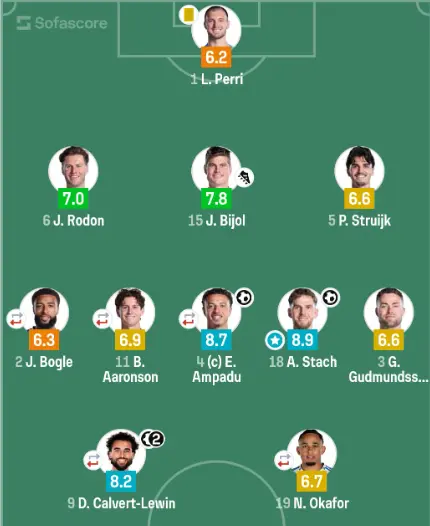
If I have to summarise Farke’s Leeds in a short form, it would be- use the long balls and use the aerial presence to win those long balls. After Leeds’ poor run, Farke shifted to a 3-5-2 and used the very orthodox methodology. Given the CBs and CF they had at their disposal, Farke decided to use their aerial presence to the maximum.
Buildup
The buildup isn’t something very inspiring; the modern-day coaches use very new techniques on build-up, but Farke used the Brexit way of football. The CBs don’t get involved in line-breaking passing; they use long diagonal balls launched towards Calvert Lewin, who wins 3.97 aerial duels per 90. He is often accompanied by either Okafor or Aaronson, who helps in the creative part and works as a decoy for Calvert-Lewin.
Attacking methods
If opponents allow them to work centrally, the midfielders Stach and Aaronson/Gruev use the space for wingbacks who deliver pinpoint crosses to the CFs and cause chaos in opponents’ box. Leeds mainly use counterattacks and dispossessing opponents via the industrious Ampadu, who further release the ball towards the wingback who are always making darting runs.
Aaronson, who is generally used as a 3rd midfielder, makes late runs and is often left unmarked by opponents. He uses the right side to create overload and combine with RWB (Bogle) doubling up on the opponents. Similar approach is used by Okafor, who uses the left side and combines with Gudmundsson.
THE X-Factor

If Leeds are at this stage, then the biggest credit goes to Anton Stach. Signed from Hoffenheim in the summer, Stach is the most important link of this team, in my opinion. Plays in the heart of the midfield with Ampadu, the German international is often responsible for creating chances, switching plays, and the dictating the tempo of the game. If not, he just steps up and scores emphatic freekicks to save his team. He has attempted 4 free kicks and has scored 2 goals. A mind-blowing stat for any midfielder
Stach is 3rd in the Chances creation list in the PL, behind Bruno and Saka. He creates 2.4 chances per 90 and delivers 1.7 successful crosses per 90. He is Leeds’ success formula; his partnership with Ampadu is the perfect fit for any manager. Ampadu stays back and acts as a protective shield for Stach. He is a great tackler and reads the situation pretty well, so he stays back and stops any sort of transition. This allows Stach to move further ahead and maximise his ability to create chances via crosses and delivering line breaking crosses.
Conclusion
Leeds have done a good job so far and have maintained a distant gap between themselves and other relegation contenders, although the league is so dynamic that tables turn very quickly. 2/3 matchdays can turn teams’ fate and their destiny. Ever since 22nd November, Leeds have faced Chelsea (h), United (h) and Liverpool (both h and a) and have won points in all the games. They have done fairly well against the rest of the teams, and would survive this season and with the Red Bull group’s Investment and brain, they are here for the long run.