

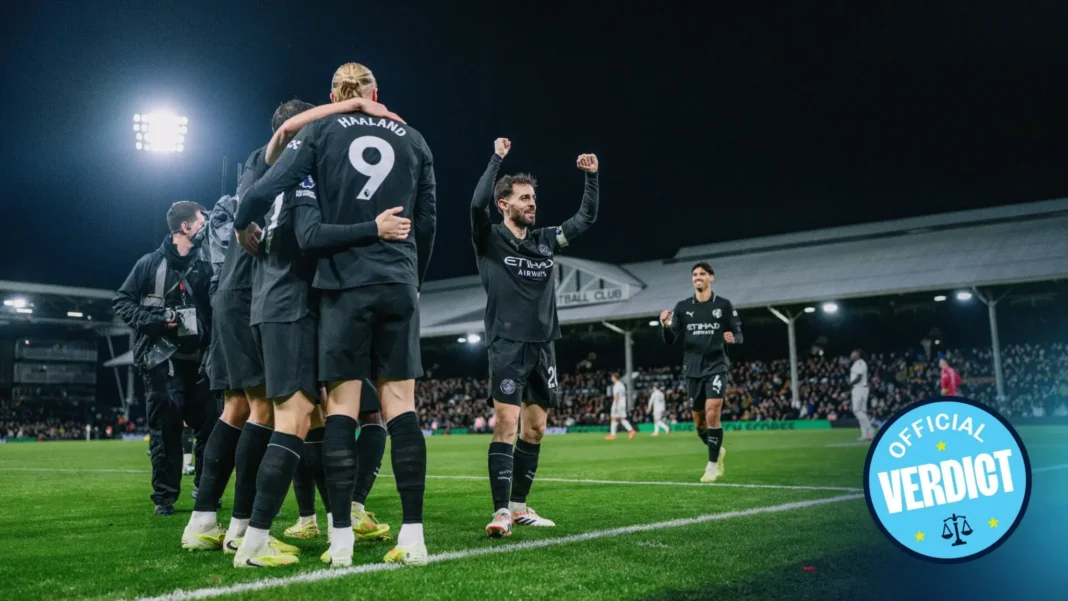

There’s a moment in every football match where you can sense the momentum shifting, where confidence evaporates, and chaos takes hold. At Craven Cottage on Tuesday night, Manchester City experienced that moment not once, but repeatedly, watching a commanding 5-1 lead dissolve into a 5-4 scoreline that required a 98th-minute goal-line clearance from Joško Gvardiol to avoid humiliation.
The body language told the story before the statistics could. At 5-2, Erling Haaland gestured for calm, reminding teammates they still possessed a cushion. At 5-3, Bernardo Silva urged 20-year-old Nico O’Reilly to retain possession, sensing danger approaching. At 5-4, Ruben Dias pleaded desperately for intensity from attackers who’d already mentally checked out.
But by that point, the damage was done. Fulham’s supporters sensed blood, recognising a team that had shifted so dramatically into reverse gear they’d forgotten how to find neutral. The home players knew it too, surging forward relentlessly in search of an equaliser that would have capped one of the Premier League’s most remarkable comebacks.
The Loss of Muscle Memory
What’s becoming alarmingly clear is that Manchester City are no longer a squad hardened by the Premier League’s relentless demands. The comfort of muscle memory, that instinctive knowledge of how to close out matches, how to strangle opponents with possession, how to protect leads, has vanished along with 1,506 Premier League appearances worth of experience that departed this calendar year.
The summer overhaul brought nine major signings from outside English football, fundamentally altering the squad’s DNA. Only half the matchday squad at Fulham has won a Premier League title. Just seven have won more than one. These aren’t players conditioned by years of Guardiola’s demands or scarred by the psychological battles that define title races.
The team is evolving, certainly, but being starved of possession for such prolonged periods is bewildering, given that ball retention has underpinned everything Pep Guardiola has achieved at City. The lack of control isn’t just tactically concerning; it’s philosophically antithetical to everything this club represents.
The Unthinkable Pattern
From 3-0 ahead, then 5-1 up, City disintegrated in real-time. Three Fulham goals in 21 minutes transformed what should have been a comfortable victory into a nerve-shredding ordeal that required Gvardiol’s desperate clearance to avoid becoming only the second 5-5 draw in Premier League history.
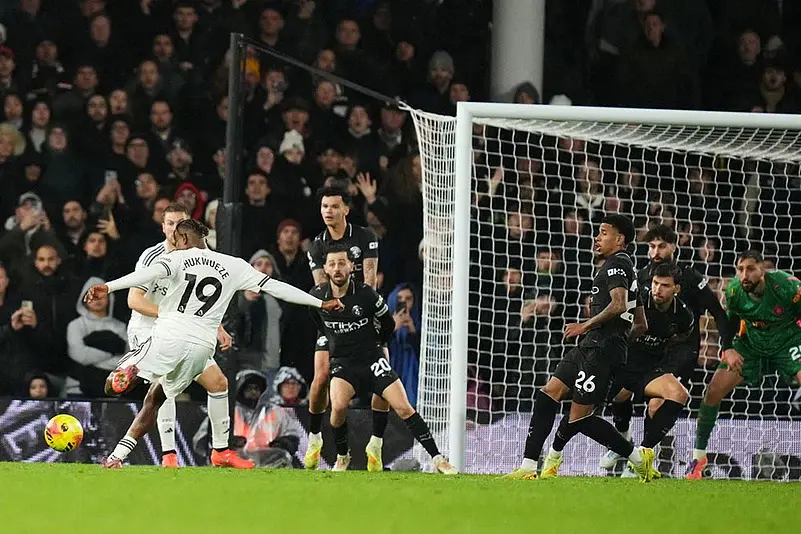 The first such draw came in Sir Alex Ferguson’s 1,500th and final match as Manchester United manager in 2013. That match had narrative justification; United were already champions, the occasion was Ferguson’s farewell, and the second half resembled a glorified testimonial where both sides prioritised entertainment over defensive diligence.
For City to go through similar motions at Fulham bordered on inexplicable. This wasn’t a meaningless end-of-season exhibition. This was a crucial fixture in a title race where every point matters, every goal difference could prove decisive, and every psychological blow weakens resolve.
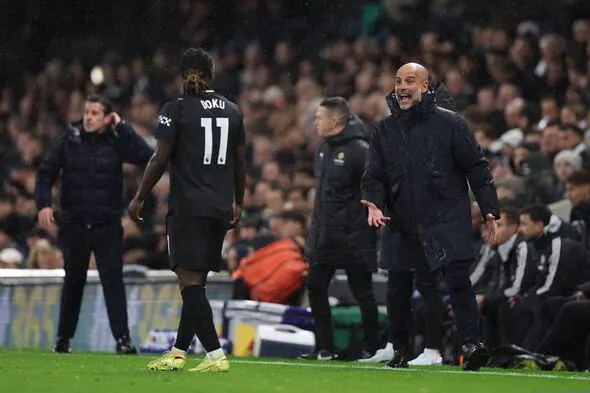
Guardiola tried finding humour in the chaos. “Did you enjoy, guys, huh?” he asked, entering the press conference. “Me? I lose my hair… At 5-1, you thought it was finished. You had written your articles. Tomorrow, Manchester City are back… finally. And after, to the trash, you have to start again.”
The self-deprecation couldn’t mask the underlying concern. By clinging on desperately in those final minutes, City moved within two points of Arsenal. But serious title contenders don’t display such unserious credentials.
The Arsenal Comparison
When examining where titles are won and lost, the dividing lines become instructive. The material differences that prove decisive over 38 matches often come down to fundamentals, and right now, City’s attitude toward defending compared to Arsenal ranks as the most glaring disparity.
There’s virtually no chance Arsenal would concede four goals in a single match, regardless of whether they win. It contradicts their identity as a team, the collective resilience, defensive organisation, and refusal to surrender that Mikel Arteta has instilled. Meanwhile, City have conceded two or more goals in their last four matches across all competitions. In their last three Premier League fixtures alone, they’ve conceded one more goal than Arsenal have managed all season.
That statistical comparison isn’t just embarrassing- it’s damning. Title-winning teams don’t haemorrhage goals at this rate. Champions don’t squander four-goal advantages. Elite sides don’t require last-gasp clearances to avoid draws against mid-table opposition.
Guardiola’s Experience vs. Current Reality
“I am the oldest manager in the Premier League and have enough experience to make a long run to try to fight to win the Premier League,” Guardiola insisted. “We won six Premier Leagues, four or five when we were in January or February, we were behind. The team that wins the Premier League is the team who grow during the months, and this is what we try to do.”
The historical precedent exists- City have recovered from worse positions to claim titles. But those squads possessed qualities this iteration lacks: experience, composure under pressure, and the instinctive knowledge of how to manage games when leading.
Tuesday’s collapse followed the exact pattern of Saturday’s 3-2 escape against Leeds United. City dominated early, built commanding leads, then watched air get sucked from them in the second halves as they proved unable to retain possession. Nico González going off at 5-2 didn’t help, removing their only fit holding midfielder during a period requiring defensive solidity, but the problems run deeper than personnel.
The Un-City-Like Trait
The most alarming development is how un-City-like this team has become. Guardiola famously wants his sides to put the ball “in the fridge” during difficult circumstances, death by a thousand passes, controlling tempo, suffocating opponents through possession. That’s been the motto throughout his tenure.
This is the first iteration of his City team where that doesn’t seem to be a priority or, more worryingly, a capability.
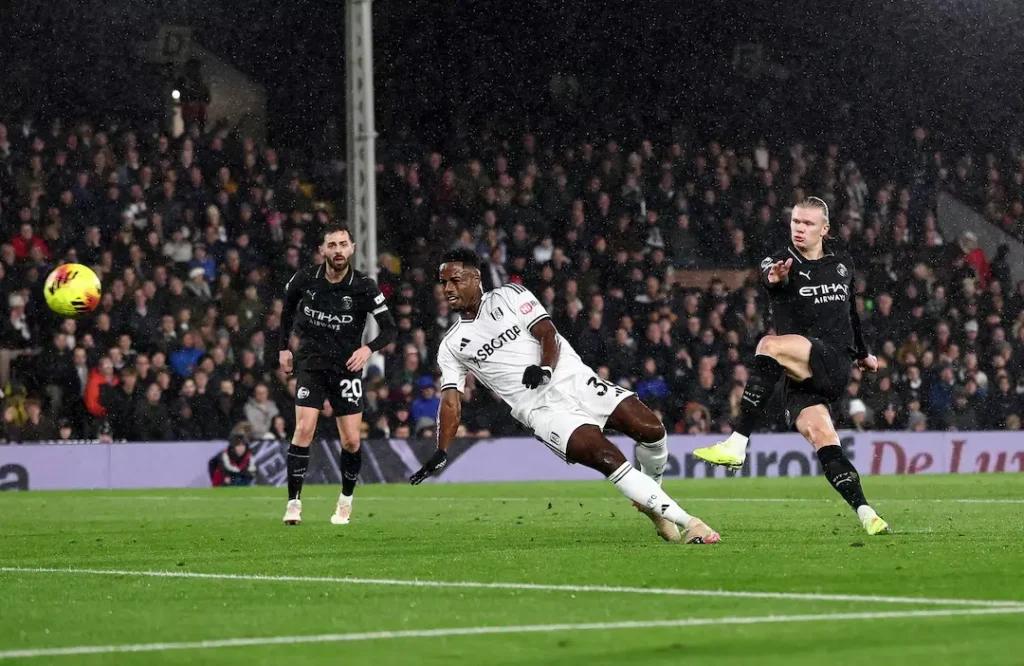
A lowly 43% possession at Fulham wasn’t an anomaly; it’s becoming the trend. The recent tendency to absorb pressure and counter-attack almost produced a sixth goal when Haaland headed against the post, but then Fulham scored their third and sitting deep became an anchor dragging City toward disaster.
 “I know you’re going to ask what happened, but I don’t have an answer. Football is emotion,” Guardiola admitted, conceding he spent the final minutes watching the clock more than the match. “We will improve because the first goal, the second one, the third and the fourth, all were on the edge and nobody was there. When we defended, we got so anxious and defended the penalty area. The others have to occupy the spaces.”
The Numbers Don’t Lie
After 41 minutes, had someone predicted Tuesday would end as the joint ninth-highest-scoring game in Premier League history, the assumption would have been City mauling Fulham into submission. That the nine goals ended up shared almost evenly represents comical mismanagement of the game state.
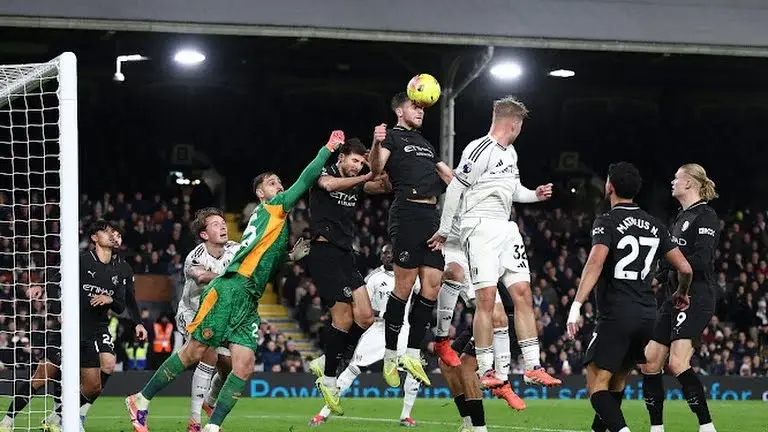 These collapses against Leeds and Fulham could have been catastrophic. Escaping with maximum points has to be viewed as a major learning opportunity and a warning that City must rediscover their ability to pass opponents into submission. Otherwise, a team lacking the players to absorb wave after wave of pressure is inviting trouble that eventually won’t be avoided by last-minute heroics.
The Uncomfortable Truth
Manchester City want to be a title contender. Their attacking quality suggests they should be. But recent results reveal a team fundamentally unprepared for the psychological and tactical demands of a title race.
You can’t concede four goals and expect to win championships. You can’t surrender possession for extended periods and maintain control. You can’t rely on individual brilliance to rescue collective disorganisation week after week.
Arsenal aren’t making these mistakes. They’re grinding out 1-0 victories, keeping clean sheets, demonstrating the defensive resilience that separates champions from nearly-men. City are doing the opposite, winning matches despite themselves, accumulating points through chaos rather than control.
The talent exists within this squad to compete for every trophy. What’s missing is the experience, composure, and collective understanding of how to close out matches when leading. Those qualities can’t be coached easily or purchased in transfer windows. They’re developed through adversity, refined through experience, and demonstrated when everything feels lost.
Right now, City are learning those lessons the hard way, through collapses, near-disasters, and performances that oscillate between brilliant and bewildering. Whether they learn quickly enough to mount a genuine title challenge remains the season’s defining question.
The clock is ticking. Arsenal aren’t waiting. And City’s recent results suggest they’re not quite ready for the fight ahead.