


Who Runs Football? Understanding the Hierarchy of Associations That Control the Game
When a referee makes a decision, fans blame the referee. When rules feel unfair, fans blame IFAB. But when corruption, governance failures, or power struggles emerge, a bigger question follows. Who actually runs football? The answer is layered, political, and far more complex than most people realise.
The Pyramid of Power in Football
Football governance operates as a hierarchy. At the very top sits FIFA. Below FIFA are the continental confederations. Below them are national associations. Then come leagues, clubs, players, and referees. Each layer governs the one below it, but answers to the one above. Understanding this structure explains almost every power struggle in football.
FIFA, The Global Authority
FIFA is the world football governing body. It organises the World Cup. It sets global regulations. It controls international eligibility. It distributes funding to confederations and national associations. Every national football association in the world is affiliated with FIFA. Without FIFA recognition, a country cannot participate in international football. Despite its power, FIFA does not write the Laws of the Game. That responsibility belongs to IFAB.
FIFA governs competition. IFAB governs rules.
Continental Confederations, The Middle Power
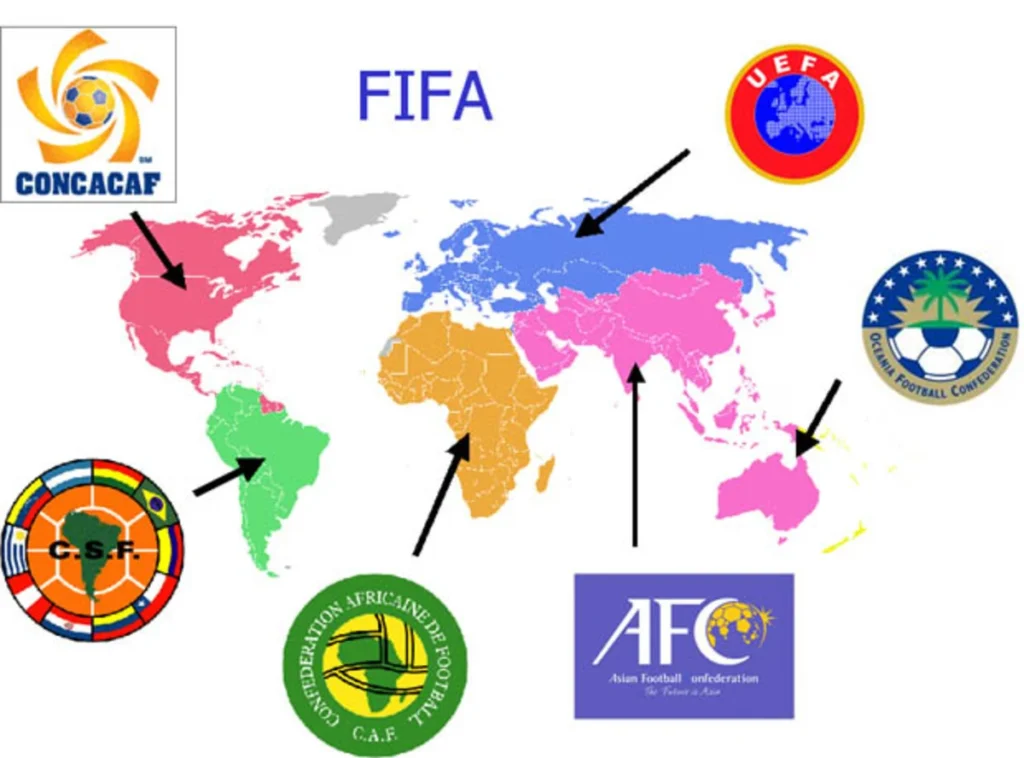
Under FIFA sit six continental confederations: UEFA for Europe, CONMEBOL for South America, AFC for Asia, CAF for Africa, CONCACAF for North and Central America and the Caribbean, and OFC for Oceania.
These bodies organise continental tournaments like the Champions League, Copa Libertadores, Asian Cup, and Africa Cup of Nations. They also act as political power blocs within FIFA, influencing elections, reforms, and global decisions. This is where football politics truly begins.
National Associations, The Domestic Gatekeepers
National football associations govern football within their countries. They oversee referees, run domestic cup competitions, set disciplinary frameworks, select national teams, and regulate leagues. In theory, they are independent. In reality, they must comply with FIFA and their confederation. When national associations face suspension, as several have over the years, domestic football collapses overnight.
Leagues and Clubs, Power Without Control
Domestic leagues like the Premier League, La Liga, or Bundesliga generate enormous revenue. Clubs employ players. Leagues sell broadcasting rights. Fans fuel the ecosystem. Yet leagues and clubs operate under national associations and confederations. This imbalance fuels tension. Clubs generate money. Governing bodies hold authority. The failed European Super League was a direct result of this conflict.
Referees and Disciplinary Bodies
Referees operate under national associations but are guided by FIFA and confederation standards. Disciplinary panels, ethics committees, and appeals bodies sit within associations, often insulated from public scrutiny. This separation protects officials, but it also creates accountability gaps that frustrate fans and clubs.
IFAB’s Unique Position
IFAB sits outside the traditional hierarchy. It does not govern competitions. It does not manage money. It controls laws. This makes IFAB both powerful and distant. No association can change the rules without it.
Where the System Breaks Down
The hierarchy works best when communication flows downward, and accountability flows upward. In practice, accountability often moves slowly. Fans blame referees. Referees cite guidelines. Associations cite FIFA. FIFA cites independence. Responsibility becomes diluted.
Why This Structure Exists
Football’s hierarchy was designed to protect the game from chaos. Uniform rules. Global access. Organised competition. Without it, international football would collapse. The problem is not the structure. It is governance quality.
Why Understanding the Hierarchy Matters
Every controversy in football can be traced through this pyramid. Rule confusion. Refereeing inconsistency. Governance scandals. Club rebellions. They are not isolated incidents. They are symptoms of a complex system struggling under modern pressure. Football has become global, instant, and emotional. Its governance remains slow, layered, and political.
The Final Question
Should football remain governed by the same hierarchical model in an era of billion-dollar clubs and global fanbases?
Or does the game need a structure that reflects what football has become, not what it once was?
Until that question is answered, football’s biggest battles will continue to be fought far away from the pitch. And fans will keep shouting at referees, unaware of how far up the ladder the real decisions are made.