

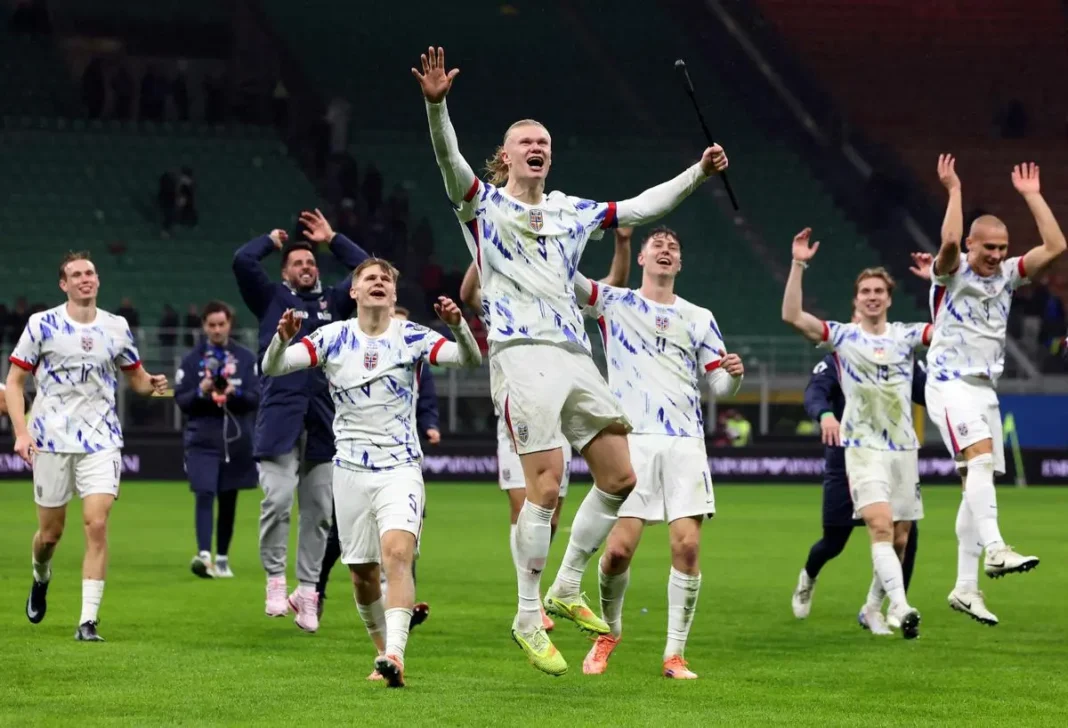

Norway’s emphatic 4-1 victory over Italy in Milan on November 16, 2025, marked more than just a qualification for the 2026 FIFA World Cup, it announced the arrival of a nation ready to compete at the highest level after 28 years in the wilderness. With a perfect eight-wins-from-eight record, 37 goals scored, and Erling Haaland’s record-breaking 16-goal haul in the qualifiers, Norway has sent a clear message to the football world: they are not here merely to participate, but to challenge the established order.
The Perfect Campaign: Eight Matches, Eight Victories

Norway’s qualification campaign was nothing short of extraordinary. Under Ståle Solbakken’s guidance, the Scandinavian side completed their journey with a flawless record, finishing six points ahead of four-time World Cup winners Italy. The numbers tell a remarkable story: 37 goals scored and only five conceded, creating a stunning goal difference of +32.
This wasn’t just about demolishing weaker opposition, Norway demonstrated their credentials against quality teams as well. The 3-0 victory over Italy in Oslo in their opening match effectively ended Luciano Spalletti’s reign as Italy’s coach and set the tone for what was to come. Their 11-1 annihilation of Moldova in September showcased the frightening attacking potential at Solbakken’s disposal, with Haaland scoring five goals in a single match, a performance that highlighted both individual brilliance and collective dominance.
The campaign’s crowning moment arrived at the San Siro, where Norway overturned a 1-0 deficit to secure a 4-1 victory. After Francesco Pio Esposito gave Italy an early lead, Norway emerged transformed after halftime. Antonio Nusa’s thunderous equalizer in the 63rd minute sparked the comeback, before Haaland delivered the decisive double blow in the 78th and 79th minutes, two clinical finishes that embodied everything this Norwegian side represents.
Haaland: The Phenomenon Leading the Charge

If there was any doubt about Erling Haaland’s status as one of football’s most lethal strikers, his qualification campaign performance erased it completely. The 25-year-old Manchester City forward scored an unprecedented 16 goals in just eight qualifying matches, double the tally of any other player in European qualifying. This remarkable achievement extended his international record to 55 goals in 48 appearances, making him Norway’s all-time top scorer at just 24 years of age.
Haaland’s impact transcends mere statistics. His five-goal haul against Moldova, three hat-tricks across the campaign, and his ability to score in 11 consecutive international matches demonstrate a player operating at the peak of his powers. Against Italy, despite being relatively quiet for 78 minutes, he produced two goals in 120 seconds that shifted the momentum irrevocably in Norway’s favor.
What makes Haaland particularly dangerous for World Cup opponents is his evolution as a complete striker. While his positioning and finishing have always been world-class, he’s now demonstrating improved link-up play and the ability to thrive even when service is limited. Norway are far more than just their number 9 but having arguably the world’s best striker in your ranks provides an X-factor few nations can match.
The Supporting Cast: A Golden Generation Emerges
While Haaland captures headlines, Norway’s strength lies in the depth and quality surrounding him. This is a genuinely talented generation across multiple positions, creating the kind of collective quality that transforms dark horses into genuine contenders.
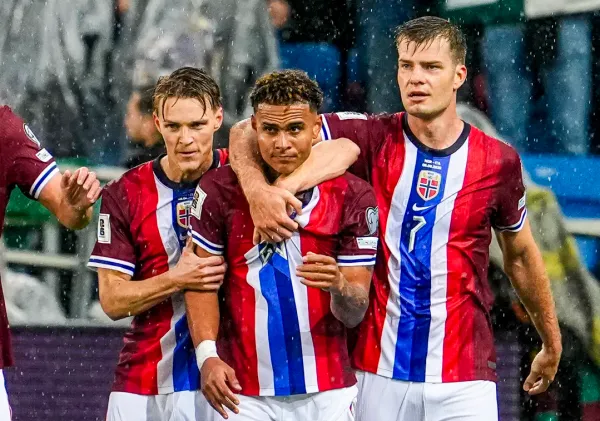
Martin Ødegaard, Arsenal’s captain and Norway’s usual skipper, provides the creative heartbeat in midfield. Despite missing the Italy match through injury, his influence throughout the campaign has been immense, his vision, technical quality, and ability to control tempo make him the orchestrator who brings balance to Norway’s attack.
Alexander Sørloth has emerged as the perfect striking partner for Haaland. The Atlético Madrid forward scored twice against Estonia and has proven himself as a world-class talent in his own right. His physical presence, intelligent movement, and clinical finishing provide tactical flexibility, Norway can deploy both strikers simultaneously or use Sørloth as an alternative, giving Solbakken options most managers would envy.
The emergence of young attacking talents Antonio Nusa and Oscar Bobb adds another dimension. Nusa, the 19-year-old RB Leipzig winger, was Man of the Match in Milan, combining electric pace, exceptional dribbling, and devastating directness. Bobb, Manchester City’s 21-year-old who has earned Pep Guardiola’s trust, offers versatility and technical sophistication on the opposite flank.
In midfield, Sander Berge provides the defensive steel and physical presence that allows Norway’s attacking talents to flourish. The Fulham midfielder’s 195cm frame, defensive intelligence, and ability to break up play create the platform for counter-attacks.
Completing the picture is goalkeeper Ørjan Nyland, whose solidity between the posts has been crucial. Norway’s defensive record, conceding just five goals across eight matches, demonstrates a team that has found balance between attacking ambition and defensive organization.
Solbakken’s Tactical Masterstroke
Ståle Solbakken deserves immense credit for transforming Norway from perennial underachievers into a cohesive, dangerous unit. The 56-year-old, who played in Norway’s last World Cup appearance in 1998, has implemented a tactical system that maximizes his team’s strengths while minimizing weaknesses.

Solbakken primarily employs a 4-3-3 or 4-2-3-1 formation built on compact defending and devastating counter-attacks. The system emphasizes high defensive lines to win possession in dangerous areas, then rapid transitions to exploit opponents’ disorganization. This approach suits Norway perfectly, they can defend with discipline, absorb pressure from technically superior sides, then unleash their pace and power in transition.
The coach’s flexibility has been equally important. Against Estonia and Moldova, Norway dominated possession and controlled matches from the front foot. Against Italy, particularly in the second half, they demonstrated resilience and tactical intelligence to overturn a deficit on hostile territory.
Solbakken’s man-management has also been crucial in handling the psychological weight of a 28-year wait for major tournament qualification. “The 25-to-26-year drought was hanging over us”, he admitted after the Estonia match. “Someone has to take that responsibility”. His ability to channel that pressure into motivation, rather than allowing it to become a burden, speaks to his coaching maturity.
Echoes of 1998: History Provides Blueprint

Norway’s 1998 World Cup campaign offers both inspiration and a potential blueprint for 2026. That team, also coached by a tactically astute manager in Egil Olsen (Solbakken’s former boss), pulled off one of the tournament’s great upsets by defeating Brazil 2-1 in the group stage.
Trailing 1-0 with ten minutes remaining, Norway scored twice through Tore André Flo and Kjetil Rekdal to claim a famous victory that secured their place in the knockout rounds. The parallels to the current team are striking: a solid defensive structure, tactical discipline, and the ability to punish opponents in crucial moments.
That 1998 side reached the Round of 16 before losing to Italy, but they had proven that a well-organized team with clear tactical identity could compete with and defeat the world’s elite. The current generation possesses significantly more individual quality than their predecessors, particularly in attack, suggesting they could potentially surpass that achievement.
Former coach Egil Olsen, now 83, has provocatively suggested that Norway could even win the World Cup, a claim Solbakken dismissed with a smile as “a bit off,” but one that captures the growing optimism surrounding the team. The more realistic goal is to progress beyond the group stage and potentially reach the quarterfinals, establishing Norway as a football nation to be reckoned with once again.
Why Norway Are Genuine Dark Horses
Several factors elevate Norway from hopeful qualifiers to legitimate World Cup dark horses for 2026:
Peak Timing
Haaland will be 26 during the tournament, exactly the age when elite strikers combine physical peak with experience and maturity. Ødegaard will be 28, Sørloth 31, while Nusa and Bobb will have additional years of top-level experience. This is a squad hitting its collective prime at the perfect moment.
Tactical Identity
Unlike many talented teams that struggle to translate club form to international level, Norway have a clearly defined playing style that suits their personnel. They know exactly how they want to play and have practiced it successfully across an entire qualification campaign.
Mental Strength
The composure demonstrated in Milan, falling behind, regrouping at halftime, then delivering a devastating second-half performance under immense pressure, reveals a team with genuine mental fortitude. These players are not overwhelmed by big moments; they thrive in them.
Low Expectations, High Quality
While pundits mention traditional powers like Brazil, Argentina, Spain, France, and England as favorites, Norway can operate under the radar. This freedom from expectation, combined with exceptional quality, creates the perfect environment for a dark horse run, much like Croatia’s 2018 World Cup final appearance.
The Haaland Factor
Morocco’s 2022 run to the semifinals demonstrated how a solid team with clear identity can succeed at World Cups. Norway possesses that foundation, but they also have something Morocco lacked: arguably the world’s most lethal striker, capable of single-handedly deciding matches against any opponent.
The Croatia Comparison: Blueprint for Success

The most apt comparison for Norway’s potential trajectory is Croatia’s stunning run to the 2018 World Cup final. Like Norway, Croatia entered that tournament as dark horses with a golden generation led by a world-class midfielder in Luka Modrić. They possessed defensive solidity, tactical discipline, and the ability to grind out results, winning three consecutive matches in extra time on their way to the final.
Croatia’s population of 3.9 million is comparable to Norway’s 5.5 million, proving that small nations with cohesive squads can compete with traditional powers. The key ingredients, a generational talent, supporting quality throughout the team, tactical coherence, and mental resilience, are present in this Norwegian side.
The crucial difference: where Croatia had Modrić dictating play from midfield, Norway possess Haaland providing a goal threat few teams can neutralize. If Norway can replicate Croatia’s tactical discipline and fighting spirit while maximizing Haaland’s unique abilities, a deep run becomes entirely plausible.
Challenges and Potential Weaknesses
Despite the overwhelming positivity, Norway must address certain concerns before the World Cup:
Tournament Inexperience
Most of this squad has never played in a major tournament. The step up in quality from qualifying to World Cup knockout football is significant. Managing expectations and handling the intensity will be critical.
Defensive Depth
While the starting defense has been solid, injuries to key defenders could expose limited depth. The reliance on Nyland in goal, while he’s performed well, means any loss of form could be problematic.
Over-Reliance on Haaland
Despite the supporting cast’s quality, there remains a concern about what happens if opponents successfully neutralize Haaland. Can Norway maintain their goal threat without their talisman firing? The Italy match suggested they can, but sustained tournament football will test this.
Ødegaard’s Fitness
The Arsenal captain’s injury history means his availability for key matches cannot be guaranteed. Without his creative influence, Norway’s midfield loses significant quality and balance.
The Road Ahead: Building Toward the World Cup
With qualification secured, Solbakken faces the challenge of maintaining momentum through the months leading to June 2026. The manager has wisely played down premature expectations, focusing on continued development rather than making bold predictions.
The extended 48-team format, featuring 16 groups of three teams, creates both opportunities and challenges. Norway will avoid some traditional powers in the group stage, but the compressed schedule and potential for shock results mean nothing can be taken for granted.
Regardless of how the draw unfolds, one truth is certain: no team will want to face Norway. A side that won every qualifying match, scored 37 goals, conceded just five, and possesses the world’s most in-form striker represents a nightmare opponent for any nation.

Norway’s qualification for the 2026 World Cup represents more than the end of a 28-year wait, it marks the emergence of a nation ready to reclaim its place among football’s elite. This is not a team making up numbers or hoping for a favorable draw. This is a golden generation, led by a generational talent, entering its prime at the perfect moment.
The perfect qualification campaign has established both confidence and credentials. The tactical identity is clear, the squad depth is genuine, and the star quality is undeniable. While calling them potential champions might be premature, dismissing their chances as genuine dark horses would be foolish.
As former coach Egil Olsen suggested, and as commentator Carl-Erik Torp boldly proclaimed after the Moldova demolition: “When I say we can win the World Cup, it sounds like I’ve been hit in the head, but I have no problem justifying that Norway can win the World Cup because all the teams that make it to the World Cup can”.
That might be optimistic, but it captures the transformation in Norwegian football. They’ve moved from hoping to qualify to believing they can compete. They’ve shifted from defensive pragmatism to attacking ambition. Most importantly, they’ve assembled a squad capable of backing up that belief with performances.
The Vikings are coming to North America, and they’re hungry. After 28 years away from football’s grandest stage, Norway aren’t just participating, they’re here to compete, to shock, and potentially to conquer. The Scandinavians have become a genuine threat, and the football world should take notice.