

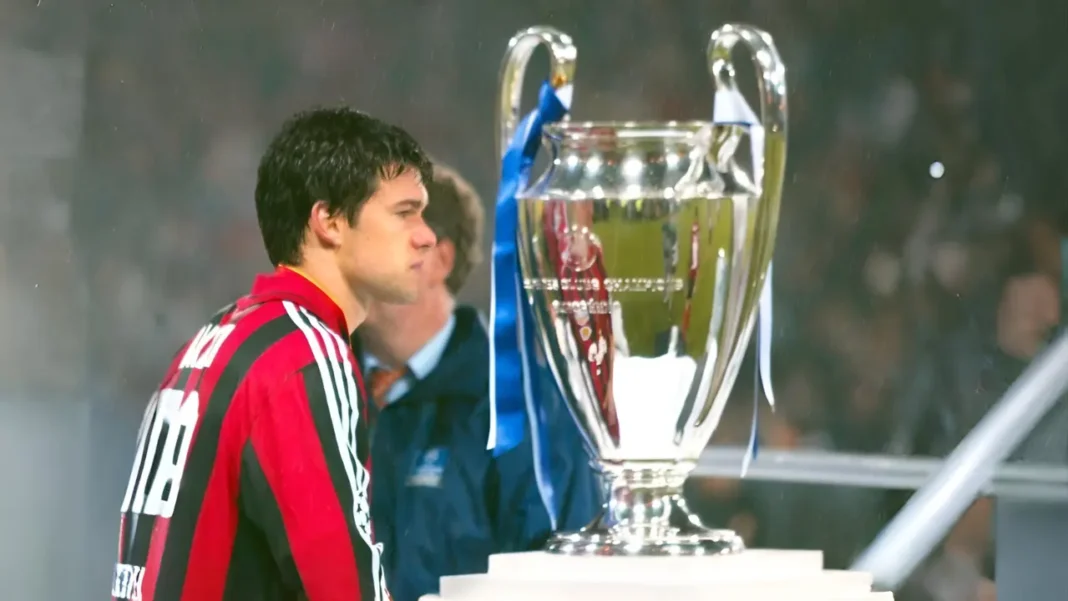

When you talk about German midfielders, names like Toni Kroos, Lothar Matthäus, and Bastian Schweinsteiger usually dominate the conversation. But there’s one man who deserves to stand right alongside them, Michael Ballack. A powerhouse in every sense, Ballack was elegant yet ruthless, technical yet tenacious. He led, he inspired, and he fought until the last whistle.
And yet, despite a trophy cabinet most players would die for, Ballack’s story is remembered not for what he won, but for what he almost did.
In Germany, they call him “Der Unvollendete,” the unfulfilled one. It’s a label that feels cruel for someone with 4 Bundesliga titles, 3 German Cups, a Premier League title, and 3 FA Cups. But for Ballack, the margins between greatness and immortality were heartbreakingly thin.
How Michael Ballack Became Football’s Unluckiest Legend
The Rise of a Relentless Competitor
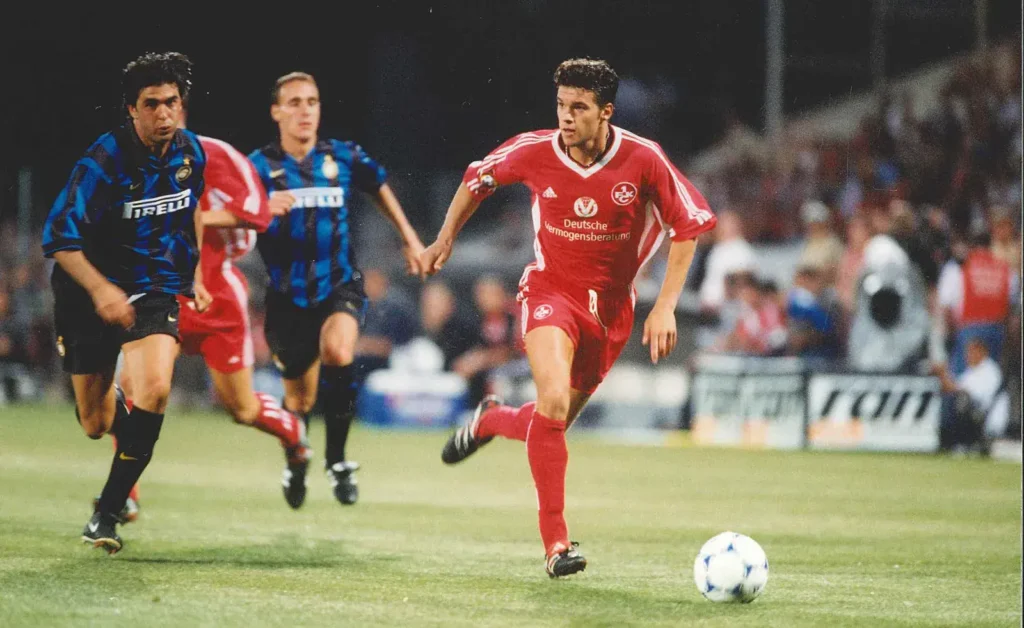
Born in 1976 in East Germany, Michael Ballack wasn’t the most gifted player of his generation, but he was the most determined. His rise through the ranks was built on hard work and precision, a player who could defend, attack, dictate tempo, and score.
By the time he arrived at Bayer Leverkusen in 1999, Ballack had already made a name for himself at Kaiserslautern, where he won his first Bundesliga title. But Leverkusen was where he became a leader, a match-winner, and eventually, the heart of one of the most tragic seasons in football history.
2002: The Year of the “Treble Horror”

If there’s one year that defines Michael Ballack, it’s 2002.
That season, Bayer Leverkusen were on the brink of immortality. They were top of the Bundesliga, had reached the DFB-Pokal final, and were preparing for their first-ever Champions League final. Ballack, playing from midfield, was at the center of everything, scoring 23 goals and dominating Europe’s best, including a masterclass performance in a 4–2 win over Liverpool in the Champions League quarter-final.
With three games to go in the league, Leverkusen sat top with a 5-point lead. Then disaster struck. Two narrow losses, 2–1 to Werder Bremen and 1–0 to Nuremberg, saw them throw away the title, finishing one point behind Borussia Dortmund.
Ballack’s misery didn’t end there. Injured and barely fit, he played through pain in the German Cup final, which Leverkusen lost 4–2 to Schalke. Then came the Champions League final against Real Madrid, where Zinedine Zidane’s iconic volley sealed a 2–1 defeat.
Within three weeks, Ballack and Leverkusen had gone from treble hopefuls to treble heartbreaks. They earned a cruel nickname, “Bayer Neverkusen.”
But the nightmare wasn’t over.
Carrying Germany to the 2002 World Cup Final
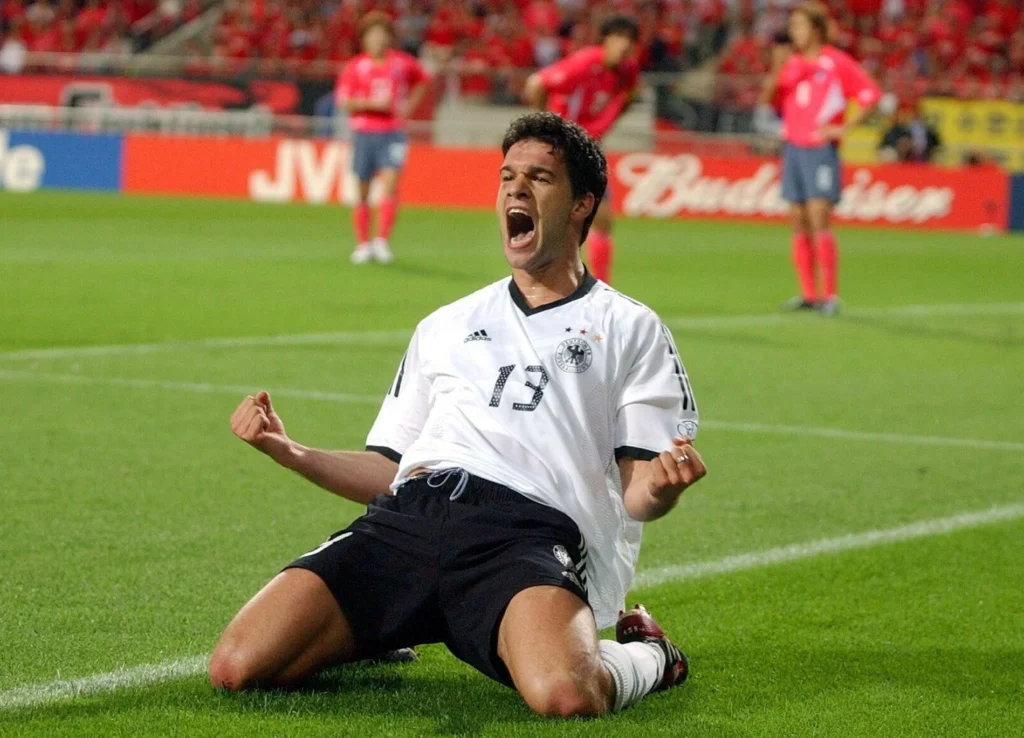
That same summer, Ballack was once again a man possessed, this time for Germany. Coming off a disastrous Euro 2000, the national team was in transition. They had no flair, no depth, and no real attacking threat. What they did have was Michael Ballack.
He dragged Germany through the qualifiers almost single-handedly, scoring crucial goals and leading from the front. At the World Cup in Japan and South Korea, he became the engine of Rudi Völler’s side, the heartbeat of a team that had no right to reach the final.
As journalist Raphael Honigstein once put it,
“Ballack didn’t just become Germany’s most important player; he became the system itself.”
Then came the cruelest twist of all. In the semifinal against South Korea, Ballack scored the winning goal and minutes later, picked up a yellow card that ruled him out of the final.
Germany would lose 2–0 to Brazil without their best player. Ballack could only watch from the stands, his dream crushed by a suspension.
That single moment led FIFA to introduce a new rule: yellow cards would now be wiped after the quarter-finals, forever known as the “Ballack rule.”
By the end of that summer, Ballack had finished second in the Bundesliga, the German Cup, the Champions League, and the World Cup. No player in football history had ever been so close to glory in so many competitions and lost them all.
The Own Goal That Started It All
It’s almost poetic that Ballack’s first taste of heartbreak came in the 1999–2000 Bundesliga season, his first at Leverkusen.
Leverkusen needed just a draw on the final day to win their first-ever league title. Instead, Ballack scored an own goal in a 2–0 defeat to Unterhaching, handing the championship to Bayern Munich.
That own goal would set the tone for the rest of his career, always the leader, always the fighter, but always one cruel twist away from triumph.
The Chelsea Years: Another Treble Horror

When Ballack joined Chelsea in 2006, he was determined to rewrite his story. And for a while, it looked like he might. He won the Premier League, three FA Cups, and established himself as one of the leaders of that fierce Chelsea dressing room.
But fate struck again in 2007–08.
Chelsea finished runner-up in the League Cup, lost the Premier League title to Manchester United by just two points, and then lost the Champions League final in Moscow a game remembered for John Terry’s infamous slip in the penalty shootout.
Ballack had played brilliantly throughout the campaign, scoring vital goals and leading by example, but once again, he ended the season empty-handed where it mattered most.
Just like in 2002, Ballack had endured a “Treble Horror.”
Euro 2008: One Last Heartbreak

Ballack’s resilience was legendary. Despite all the near misses, he continued to carry Germany through the mid-2000s. At Euro 2008, he captained his country to the final, scoring decisive goals against Austria and Portugal.
But yet again, the football gods weren’t kind. Germany lost 1–0 to Spain a team that would go on to dominate world football for years.
Ballack had once again finished second on four fronts: the Premier League, the League Cup, the Champions League, and the European Championship.
Twice in his career, he had been runner-up in four different competitions in a single season.
The End of an Era
By the late 2000s, Germany’s new generation was emerging, Özil, Schweinsteiger, Müller, Kroos, all of whom would carry the team to the 2014 World Cup. Ballack, the man who had kept German football relevant during its darkest years, didn’t make it to the 2010 tournament.
An injury ruled him out, and by the time he recovered, the team had moved on. His fallout with Joachim Löw ended any hopes of a farewell match. He even turned down a symbolic 100th cap, calling it “a farce.”
For a man who had given everything to his country, that was a bitter goodbye.
The Legacy of Michael Ballack
Michael Ballack’s career ended with 11 major trophies, a record that many players would envy. But his legacy isn’t measured in medals. It’s measured in near-misses, in heartbreaks, and in the sheer willpower that kept him coming back stronger each time.
He was a complete midfielder before the term became fashionable, strong in the air, clinical from distance, and tactically flawless. Managers trusted him. Teammates followed him. Opponents respected him.
But luck? That was one thing Ballack never had.
When you look back, it’s hard not to imagine what could have been. If Leverkusen had held their nerve in 2002. If he hadn’t been suspended for the World Cup final. If Terry hadn’t slipped in Moscow.
Had those moments gone differently, we might be talking about Michael Ballack in the same breath as Xavi, Iniesta, or even Zidane.
When Ballack retired, he summed up his career in one simple sentence:
“Titles are sometimes overrated.”
Coming from anyone else, that might sound like an excuse. But from Ballack, it feels like wisdom.
Because Michael Ballack’s story isn’t one of failure. It’s one of resilience, leadership, and heartbreak, the kind that reminds us football isn’t just about what you win, but how you fight for it.
He may be “Der Unvollendete” to some, but to those who watched him command every pitch he stepped on, he’ll always be the complete midfielder who deserved so much more.