


In the sweltering heat of a Merseyside summer, Liverpool FC unleashed a staggering £450 million on new talent, aiming to ignite a new era of dominance under Arne Slot. Fresh off a triumphant 2024–25 Premier League title, the Dutchman took full control of Anfield’s war chest, tasked with building a modern dynasty.
Liverpool didn’t hesitate. They secured Florian Wirtz for £116.5 million from Bayer Leverkusen, shattered the British transfer record by landing Alexander Isak for £125 million, and bolstered the attack further with Hugo Ekitiké for £40 million. Jeremie Frimpong (£29.5m), Milos Kerkez (£40m), and Giorgi Mamardashvili (£29m) completed a window designed to electrify a squad already boasting icons like Mohamed Salah and Virgil van Dijk.
The club promised a seamless fusion of youth, experience, firepower, and flair, a squad built to defend the Premier League crown and conquer Europe once again.
As of November 10, 2025, the defending champions sit eighth in the Premier League with just 18 points from 11 games. What was supposed to be a £450 million evolution has, so far, spiraled into a harsh awakening. They’ve conceded 17 goals, the worst defensive record for any reigning champion at this stage since their own collapse in the 2020–21 season.
So what went wrong? How does a club that outspent Manchester City and Arsenal by a mile now find itself closer to the drop zone than the title race?
Liverpool’s total outlay nearing £450 million made them the Premier League’s biggest spenders, even surpassing Chelsea’s infamous free-for-all window. “We’ve assembled a squad for the next decade,” Slot proclaimed in July, his voice full of Dutch pragmatism.
But ambition often casts a shadow. In football’s high-stakes poker game, Liverpool went all-in on untested chemistry. The new arrivals, brilliant as individuals, have been forced into a system still shedding the remnants of Jürgen Klopp’s high-octane identity. Slot’s possession-heavy “tweaks” more patient build-up and inverted full-backs clashed with the players’ natural tendencies.
Wirtz, a maestro in Leverkusen’s fluid 3-4-3, now drifts through games in Liverpool’s rigid 4-3-3. Isak, who thrived on service at Newcastle, now starves in a team struggling to create. The end result? A squad valued at £1.15 billion on paper, but performing like a mid-table patchwork.

Tactical Tinkering: Slot’s Slot Machine Breaks Down
Liverpool’s tactical struggles stem from a combination of interconnected issues:
- Over-reliance on sterile possession: Slot’s emphasis on controlling the ball has made Liverpool predictable. Opponents now sit deep, clog central lanes, and wait for Liverpool’s slow build-up to break down.
- Creativity vacuum: The attack often stalls in the final third. Movements that once carved open defences now look rehearsed and rigid, leaving the team without clear, incisive chances.
- Neutralised pressing and counters: Teams have cracked Liverpool’s high-press blueprint. Opponents now invite the press, play through the first line, and launch quick counters that repeatedly catch Liverpool out of shape.
- Set-piece fragility: Set pieces have become a glaring weakness. Poor back-post awareness, inconsistent marking, and slow reactions have cost Liverpool six goals from dead-ball situations—an unthinkable drop-off from previous seasons.
- Tactical inflexibility: Slot’s reluctance to adjust shapes or tempo mid-game has turned Liverpool into a one-gear side. Opponents who plan for their patterns often shut them down with ease.
- Loss of natural flair: The team’s instinctive, free-flowing attacking combinations have faded. Players who once thrived in chaos now look constrained, producing a blunt, sparkless final third.
Together, these flaws have undermined Liverpool’s identity and fuelled the inconsistent performances that define their season so far.
A Team Falling Apart: Defensively Fragile, Attackingly Blunt, Creatively Empty:
Liverpool’s problems don’t end with tactics; they break down in every department.
Defensively
The team looks alarmingly fragile. The back line no longer tracks runners, wins duels, or controls the box with authority. Simple balls over the top split them open, and crosses into the back post cause panic every single time. Van Dijk and Konaté often stand isolated, exposed by midfielders who fail to shield and full-backs who push too high without recovering. A unit that once dominated transitions now collapses under the slightest pressure.
Having no depth for their main center backs also raises more issues with Liverpool having heavily targeted Palace’s Marc Guehi, whose deal eventually fell through due to no incoming replacements for Palace.
In attack:
Liverpool looked blunt and predictable. The forward line, once the most explosive in Europe, now moves without conviction. Ekitike routinely drops deep to find the ball because service never comes. Wingers receive the ball too wide, with two defenders already waiting and also ready to double up on players if necessary. The team rarely creates overloads, breaks lines, or forces mistakes. Attacks stall, shots dry up, and opponents defend comfortably for long stretches. Salah’s form and age also play a huge factor in his not being able to replicate what he did last season.
Creatively:
The midfield has lost all spark. The players who should dictate tempo and find killer passes instead opt for safe, sideways balls. No one carries the ball through pressure, no one threads vertical passes, and no one links midfield to attack with purpose. Wirtz often drifts into pockets without receiving the ball, while Szoboszlai and Mac Allister struggle to influence the game in the final third. The once Liverpool team, known for aggression, now thinks twice before making any tackle, as seen in the Man City game, getting completely overwhelmed by the City midfield.

Positional Mismatches: Szoboszlai at RB and Kerkez as an Inverted Fullback: An Analytical Breakdown
Slot faced an injury crisis and responded with aggressive positional reshuffles, but the data shows that these decisions created structural problems across the pitch. When he moved Dominik Szoboszlai to right-back, Liverpool gained short-term output but sacrificed long-term stability. Szoboszlai delivered early impact; he claimed MOTM awards against Newcastle and Arsenal, covered 11.2 km per game, and made 158 tackles. These numbers made the adjustment look effective, but they hid the underlying risks of placing an attack-minded midfielder in a high-exposure defensive role. Opponents quickly identified this weakness and targeted his zone.
In the loss to Galatasaray, Szoboszlai lost a sprint duel and committed a handball, errors that produced 1.2 xGA from his flank alone. Slot later admitted that he “gambled,” and the metrics support that assessment: by pulling Szoboszlai out of midfield, Liverpool reduced their central recoveries by 16% and weakened their ability to maintain counter-pressing sequences.
Slot created a similar mismatch when he inverted Milos Kerkez. Liverpool signed Kerkez for his overlapping profile he registered 237 overlaps and 6 assists for Bournemouth but Slot asked him to operate like Andy Robertson, prioritizing inside positioning and controlled build-up. This shift has directly suppressed Kerkez’s strengths. He now makes 35% fewer overlaps (down from 6.8 to 4.4 per 90) and 22% fewer progressive carries. These reductions have contributed to an 18% drop in Liverpool’s left-side xG. Although Kerkez increased his interceptions to 117, his improved defensive activity does not compensate for the loss of width, vertical runs, and byline creation.
At Bournemouth, he thrived in high-tempo sequences, logging 616 sprints and generating 0.6 xA per match through aggressive cutbacks. Slot’s inverted system restricts these actions, reduces his forward touches, and limits his ability to stretch defensive blocks. Analysts consistently point out this tension: Kerkez wants to attack space and overlap, while Slot demands positional discipline to protect rest-defense.
Together, these experiments show a clear pattern. Slot filled immediate squad gaps by repurposing players, but these moves disrupted Liverpool’s structure. The numbers reveal that the positional changes reduced midfield control, suppressed left-side creativity, and lowered overall chance quality.
Are Trent Jota and Luis Díaz That Big of a Miss? Understanding What Liverpool Lost

Liverpool’s recent struggles became easier to understand when you examined what Trent Alexander-Arnold and Luis Díaz usually provided. Trent once drove Liverpool’s creativity from deep zones. He consistently progressed play with early diagonals, inverted midfield entries, and high-volume chance creation.
Last season alone, he produced elite output: top-tier progressive passes, constant switches that stretched blocks, and repeated line-breaking passes that activated the right half-space. When he dropped out, Liverpool lost their primary source of controlled progression. Slot’s system no longer had a natural tempo-setter, and the team struggled to connect buildup to the final third with the same clarity.
Luis Díaz delivered a completely different but equally vital impact. He elevated the left flank with relentless work rate, defensive intensity, and direct ball-carrying. His ability to press 1v1, recover quickly, and re-engage duels gave Liverpool a natural counter-pressing trigger.
In possession, he destabilized defensive lines with vertical dribbles, sharp inside cuts, and second-phase runs. Without him, Liverpool’s left side lost energy, width, and unpredictability. The team also missed his ability to turn chaotic sequences into productive territory gains that Kerkez and others could not replicate under the tactical instructions at the time.
Diogo Jota added another layer Liverpool previously lacked: ruthless end-product and high-efficiency movement. He provided sharp, well-timed runs into the box, intelligent blind-side positioning, and an ability to finish chances with minimal touches. Jota also pressed aggressively, often acting as the first trigger in Liverpool’s defensive sequences. His knack for scoring from half-chances regularly bailed the team out when the buildup lacked fluency.
Without him, Liverpool lost a guaranteed source of goals, a connector in transitional moments, and one of the squad’s most instinctive movers inside crowded penalty areas. His absence forced Liverpool to rely more heavily on players who preferred to receive to feet rather than attack space, making the attack flatter and easier to defend.
Collectively, Trent, Díaz, and Jota gave Liverpool structure, intensity, and cutting edge. Removing all three meant the team didn’t just lose individual quality it lost the core behaviors that had once defined its identity.
Liverpool’s Identity Drop Off:
1. Creativity and Progression Drop-Off
- Without a consistent deep-playmaker or creative trigger, Liverpool lose their natural tempo-setters or intensity (e.g., the missing link from Trent’s absence or cross field deployment).
- The defence’s instability(Van Dijk’s form) forces more conservative positioning in midfield and wide areas which reduces progressive passes, switches, and carry momentum that once defined Liverpool’s attacking identity.
Implication: The team can still create chances, but fewer of them will be high-quality, well-orchestrated opportunities. That increases dependency on individual brilliance rather than cohesive attacking patterns.
2. Identity Crisis and Assimilation Lag
- The tactical model under Arne Slot appears unsettled: Liverpool seem unclear whether they want to dominate possession from the back, press in high intensity, sit deeper and counter, or use wide overlaps aggressively.
- For new signings or mis-positioned players (e.g., full-backs shoe-horned into unfamiliar roles), the lack of a coherent playing identity complicates adaptation.
- This mismatch shows up in defensive errors, inconsistent attacking runs, and a “hesitant” look when building from midfield.
Implication: Players need clarity of role and predictable team behaviour to thrive. Without that, even talented individuals underperform, and the team’s “machine” misfires.
3. Pressing & Transition Inefficiency
- A hallmark of the previous era was the first-30-metre press plus quick transition to attack. This season, with more defensive instability and less progressive momentum, Liverpool’s press triggers look less sharp and their transitions appear slower.
- These behaviours often show up in cumulative metrics like high turnovers conceded in final third build-ups and fewer fast-break opportunities.
Implication: Transition football (press → recover → attack) requires cohesion, predictable triggers, and structural integrity. When one part fails (e.g., defence), the chain breaks.
“Liverpool’s Season in Microcosm: Salah Less Dominant, Van Dijk Under Siege”
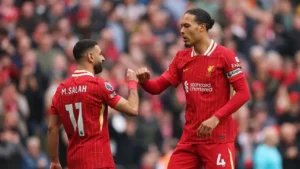
Mohamed Salah: Output Still Decent, Influence Declining
Salah continues to produce goals and assists at a respectable rate, but his overall influence on games has dropped. His touches in the box, progressive carries, and high-intensity sprints have declined, which makes Liverpool’s right side far less threatening. With the team lacking structure and tempo, Salah often receives the ball deeper and wider, forcing him into low-value dribbles rather than decisive final-third actions. He remains productive, but not dominant and Liverpool feel that difference sharply.
Virgil van Dijk: Strong Individually, Exposed Collectively
Van Dijk’s individual metrics, duels won, aerial dominance, and defensive positioning remain solid, but he now defends in a far more chaotic environment. The instability around him (rotating fullbacks, inexperienced partners, poor midfield coverage) forces him to defend larger spaces and react to breakdowns instead of controlling the line proactively. He still performs well in isolation, yet he cannot compensate for the structural gaps around him. As a result, even small defensive errors become costly.
Summary:
Liverpool’s struggles can be traced to three interconnected factors backed by data:
- Defensive vulnerability (notably full-back exposures) which erodes confidence and structure.
- A drop in creative progression and tempo-setting play, reducing attacking fluidity.
- Tactical uncertainty and identity drift, making it harder for players to execute roles or new signings to embed.
Addressing one in isolation (e.g., plugging a defensive leak) helps, but unless the club realigns its playing identity and rebuilds progression pathways, the underlying problems will persist.
How Liverpool Can Fix This Crisis:
1. Restore Defensive Organisation and Compactness:
Liverpool must tighten their shape both vertically and horizontally. At present, the distances between the lines are far too wide, leaving the back line exposed to even the simplest attacking patterns.
- The midfield must drop closer to the centre-backs to shield transitions.
- Full-backs must time their forward runs more intelligently; both cannot advance simultaneously.
- Slot must reintroduce coordinated pressing triggers, replacing the passive possession-first approach.
A compact Liverpool is a stable Liverpool, and defensive stability is the foundation of any recovery.
2. Simplify the Build-Up and Increase Tempo:
Liverpool’s slow, predictable build-up play is suffocating their attacking rhythm. A slot can restore tempo by:
- Dialing back over-choreographed passing sequences.
- Encouraging quick switches of play to stretch deep defensive blocks.
- Allowing midfielders to play vertical passes earlier instead of recycling the ball.
- Bringing back third-man runs that disrupt opposition structure.
The aim is to revive the speed, spontaneity, and directness that once defined Liverpool’s most dangerous attacks.
3. Rebuild Creativity Through a Defined No. 10 Role:
Wirtz and Szoboszlai currently operate without clear creative zones, leaving Liverpool’s final third lifeless. Slot must:
- Free Wirtz to roam centrally as the team’s primary creator.
- Push Szoboszlai higher, rather than assigning him deeper build-up responsibilities.
- Anchor the midfield with Mac Allister or Endo to give others the license to attack.
Liverpool needs a midfield that feeds the forward, not one that isolates them.
4. Redefine Isak’s Role Through Consistent Service:
Isak is a world-class finisher, not a self-creator. To unlock him, Liverpool must deliver better service:
- Provide earlier crosses from the half-spaces.
- Tuckwingers inside to operate closer to him.
- Use overlapping full-backs to force defensive disorganisation.
Give Isak chances, and he will convert them. Without service, Liverpool’s record signing will continue to drift out of games.
5. Embrace Tactical Flexibility:
A slot cannot persist with a rigid blueprint in a league that punishes predictability. Liverpool should:
- Shift to a 4-2-3-1 when they need more control and stability.
- Use the 3-2-5 positional play only when personnel naturally suit the structure.
- Adjust pressing intensity based on the opponent’s ability to build from the back.
Liverpool’s season is a stark reminder that even the biggest investment cannot instantly buy cohesion, identity, or results. The £450 million splurge has exposed cracks in tactics, defence, creativity, and mentality, leaving a team once feared across Europe looking unrecognisable.
Yet, the talent is there, and the potential to recover remains real if Arne Slot can restore structure, unlock creativity, and reignite the intensity that once defined Liverpool. For the Reds, the road back will not be easy, but with decisive adjustments, they can still salvage their season and prove that a half-billion-pound gamble can evolve into a dynasty rather than a cautionary tale.