

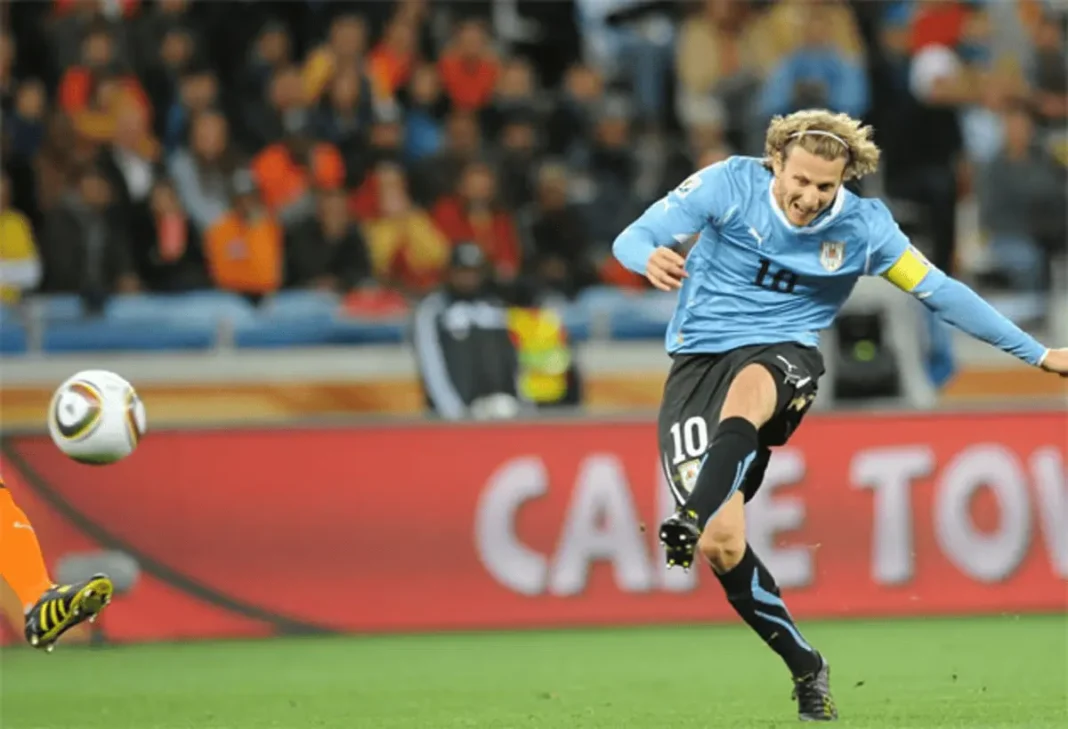

It was the summer of 2010, and the world’s best players were in open revolt. The Jabulani, Adidas’s 11th World Cup ball, was being called everything from a “supermarket ball” to a “beach ball.” Goalkeepers watched it swerve late, strikers watched it sail over the bar, and the vuvuzelas drowned out the complaints.
But amidst the noise and the unpredictable dips, one man was quietly turning the chaos into his greatest ally. Diego Forlán didn’t just tolerate the Jabulani; he mastered it.
While luminaries like Buffon and Casillas publicly decried the ball’s erratic aerodynamics. Forlán treated it like a puzzle he had already solved. The Uruguayan striker realized early that the Jabulani’s lack of spin, which was a byproduct of its minimal eight-panel design, wasn’t a flaw, but a feature he could exploit. He spent hours on the training pitches of South Africa, learning exactly how to strike the ball to make it dip violently at the last second.
The result was a highlight reel of impossible goals: dipping volleys against Germany, swerving free-kicks against Ghana. He didn’t just play the tournament; he bent it to his will, winning the Golden Ball not despite the equipment, but because he was the only one who understood it.
History Repeats: Yamal Gets the New WC Ball Early

Fifteen years later, whispers from the training grounds suggest that history is repeating itself. Lamine Yamal, the teenage prodigy who has become the face of Adidas’s future, has reportedly been training with the “Trionda”—the official 2026 World Cup ball.
Months before its global release. Just as rumors once swirled that Forlán had secret access to the Jabulani (a myth he later debunked, citing only obsession and practice), reports from Barcelona suggest Yamal has been living with the new ball since late summer.
The advantage of this “early access” cannot be overstated. Every World Cup ball carries a unique personality. A specific weight distribution, a distinct texture, a new way of cutting through the air. By spending months acclimating to Trionda’s touch, Yamal isn’t just learning to dribble. He’s learning the ball’s secrets before the rest of the world even gets a touch. It is a passing of the torch: from the Uruguayan veteran who studied the physics of flight late into the night, to the Spanish wonderkid.
THE SCIENCE BEHIND THE RUMOURS :
A Ball Unlike the Rest
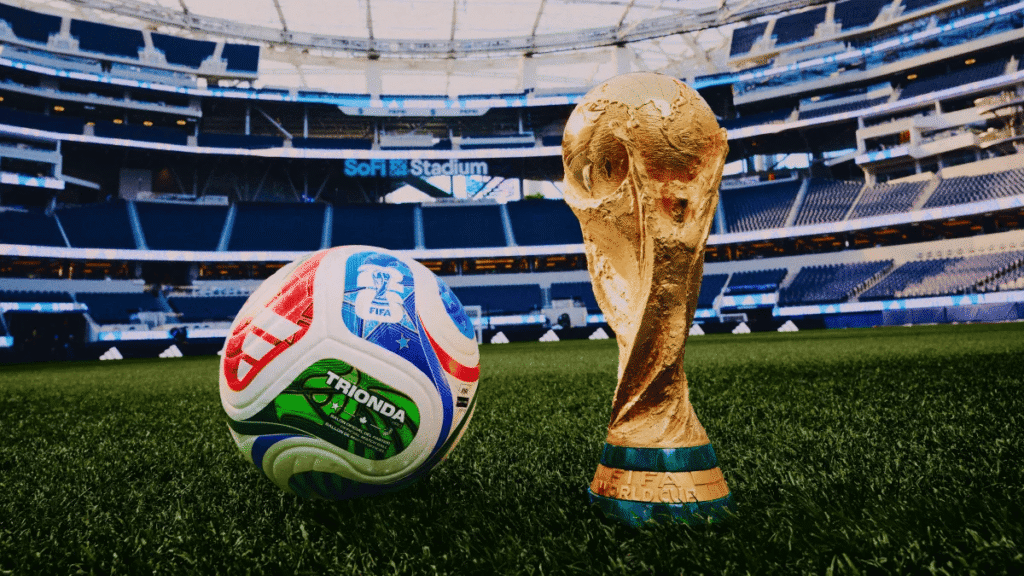 So, what is the Trionda?
If the Jabulani was defined by its chaotic unpredictability, the Trionda is defined by its aggressive correction of it. The rumors are true: this year’s ball features a radical four-panel design—the fewest in history.
In the past, fewer panels meant more “knuckleball” instability (the Jabulani effect). However, modern engineering has flipped the script.
The Trionda utilizes “deep seam” technology and a “fluid geometry” that intentionally disrupts air flow to stabilize the flight path. It also hides a secret deep within its core: a side-mounted 500Hz chip with counterweights in the opposing panels to ensure perfect balance.
Where the Jabulani wobbled mid-flight like a knuckleball pitcher’s best throw, the Trionda is designed to lock onto a trajectory like a guided missile. It is faster, yes, but it demands a cleaner strike. The “sweet spot” is smaller, but if you hit it, the ball doesn’t just fly—it travels on a rope.
EVEN THE GREATS STRUGGLED: Messi with Jabulani in the 2010 World Cup
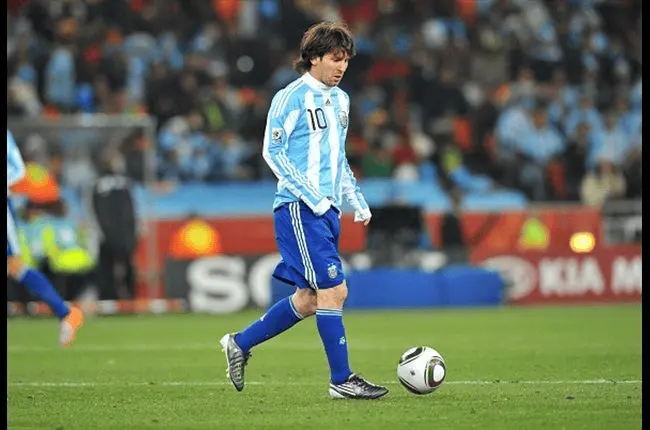
Lionel Messi was one of many stars who complained that the Jabulani was difficult and unpredictable. Saying it was complicated both for goalkeepers and forwards because of how strangely it moved in the air.
Messi’s 2010 World Cup was a paradox: he took 29 shots. Most of any player at the tournament, but finished with 0 goals and just one official assist. Despite generating the highest non‑penalty expected goals among those who failed to score. He hit the woodwork multiple times and created numerous chances. Yet the combination of poor finishing, bad luck, and the infamous Jabulani meant the numbers never matched the quality of his overall play
Reports at the time noted that even Diego Maradona. Then Argentina’s coach suggested the ball’s flight was part of why Messi was not at his usual devastating level. Renforcing the idea that even the greatest talents were fighting against the technology. Many articles and analyses pointed out that the Jabulani felt too light and “floaty,” behaving unlike the balls that top players had mastered in club football.
CAN YAMAL BECOME THIS GENERATION’S FORLÁN?

We are left with one burning question as the World Cup approaches.
Will Lamine Yamal do what Diego Forlán did in 2010? The parallels are intoxicating. Both players possess an innate, almost artistic understanding of the game. Both faced a ball that the world deemed “difficult.” It seems that, decided that the only way to win was to turn that difficulty into a weapon.
Forlán’s legacy was cemented not just by goals, but by the feeling that he knew something no one else did. Yamal now stands on the precipice of that same opportunity.
If he can harness Trionda’s speed and master its unique four-panel flight while defenders are still adjusting to the trajectory, he won’t just participate in the World Cup; he will own it. The stage is set, the ball is waiting, and the world is watching to see if the apprentice can become the master.