

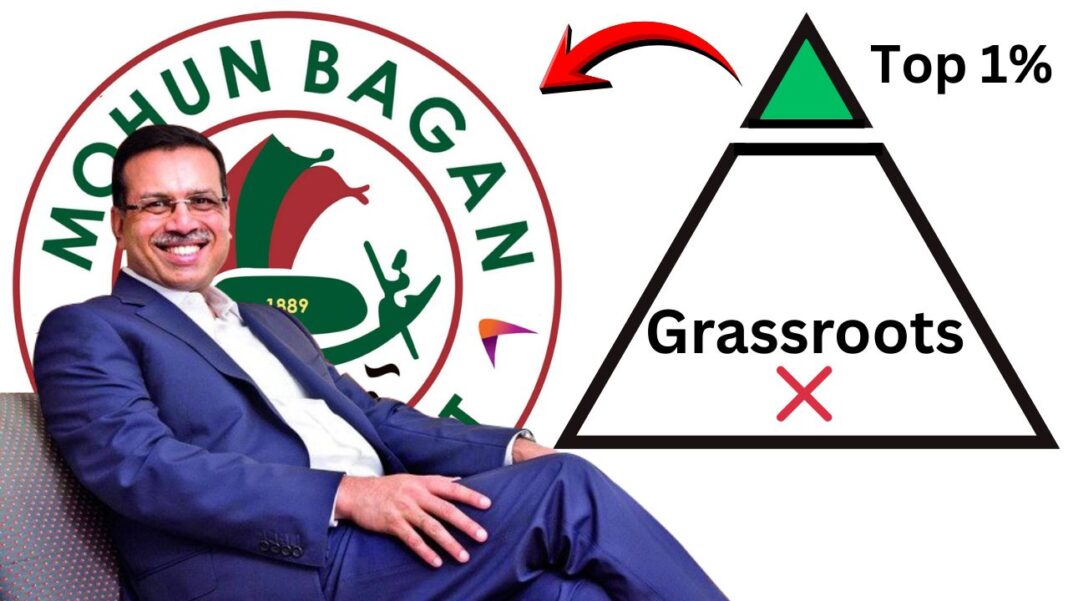

Every time a big event happens in Indian football, the same argument appears. That money should have gone into grassroots development. Whether it is a marquee signing, a league expense, or a federation project, the response is always the same.
If we had invested this amount in grassroots, we would have produced the next Messi. It sounds logical. It also ignores how football economics actually work.
Everyone talks about grassroots. Almost no one is willing to invest in it. There is a reason for that.
How the global academy model really works
Let us step away from India for a moment.
In Europe and South America, elite academies operate on a business cycle. Clubs like Barcelona, Ajax, Benfica, Porto, and Sporting invest heavily in youth systems. These academies do not exist just to develop talent for the first team. They exist to generate transfer revenue.
The global success rate is brutal. Even at the best academies, only 3 to 4 percent of players make it to the professional level. The rest drop out.
Running a serious youth academy costs money. Training grounds, coaches, medical staff, nutrition programs, scouting networks, travel, housing, and education. On average, a well-run academy costs between two to six million euros per year. Some go even higher.
So why do clubs keep investing? Because one major sale can fund the system for years.

When West Ham sold Declan Rice for over 100 million euros, that single transfer covered the academy budget for more than a decade. That is the model. Develop, sell, reinvest, repeat.
The Indian reality is completely different
Now bring this structure back to India. The Indian Super League does not have a functional transfer market. It barely exists.
Most players sign short contracts. Foreign players usually stay for one season. Domestic players move on free transfers or minimal fees. Clubs rarely pay meaningful transfer fees to each other.
The biggest domestic transfers in Indian football history sit around three to four crore rupees. That is not sustainable income. That is pocket change compared to what it costs to operate a serious academy.
Without a transfer ecosystem, there is no financial return on player development.
Academy costs in India are not cheap either
There is a myth that grassroots development in India is cheap. It is not.
Setting up a proper academy requires land, training facilities, residential programs, qualified coaches, fitness staff, and full-time management. Initial investment can easily touch twenty to twenty-five crore rupees. On top of that, annual operational costs sit around two to three crore rupees if you want to do it properly.
Now ask the obvious question. Why would anyone invest that amount when there is no reliable return?
If a club develops a talented player, that player can leave for free. There is no structured compensation system. There is no guarantee of transfer income. The entire risk sits on the investor.
From a business perspective, this makes no sense.
The pipeline problem
Even if you produce good players, there is no clear professional pathway.
In Europe, youth players move through age-group leagues into reserve teams and then senior squads. The ladder is structured. In India, the ladder is broken.
The slots are limited, the league is highly unstable, and youth leagues lack consistency. Players fall out of the system before reaching the senior level.
Dropout rates in India are higher than global averages. That makes the investment risk even worse.
Why clubs avoid grassroots spending
ISL clubs operate in a low-revenue environment. Broadcast money is limited. Matchday income is inconsistent. Sponsorships are unstable.
When budgets are already tight, clubs choose survival over long-term development. Instead of running expensive academies, they rely on scouting networks and agent recommendations to sign ready-made players.
It is cheaper. It is safer. It is immediate.
Grassroots development is slow, expensive, and uncertain.
Infrastructure and bureaucracy make it harder
On top of football problems, India adds structural problems.
Land acquisition, permissions, government processes, legalities, infrastructure costs and maintenance, at everystep there is a hindrance which makes the whole process slow and very expensive.
Setting up one elite academy is already hard. Scaling it across regions becomes nearly impossible without institutional support.
The uncomfortable truth
People like to talk about grassroots because it sounds idealistic. The reality is harsher.
Right now, Indian grassroots football survives on passion, not profit. The few serious academies that exist are funded by individuals or organizations that care about the sport, not because it makes financial sense.
From a pure business standpoint, the current system is unsustainable.
Without a strong transfer market, stable leagues, compensation mechanisms, and government or federation backing, grassroots investment remains a financial black hole.
What would actually change this
For grassroots to become attractive, the ecosystem must change.
There needs to be a functioning domestic transfer market. Solidarity payments must be enforced. Youth development compensation must exist. League stability must improve. Revenue distribution must become predictable.
Until that happens, the economics do not support large-scale grassroots investment. People will keep talking about it. Very few will fund it. And that is why, in the current Indian football structure, grassroots is not worth investing in.