

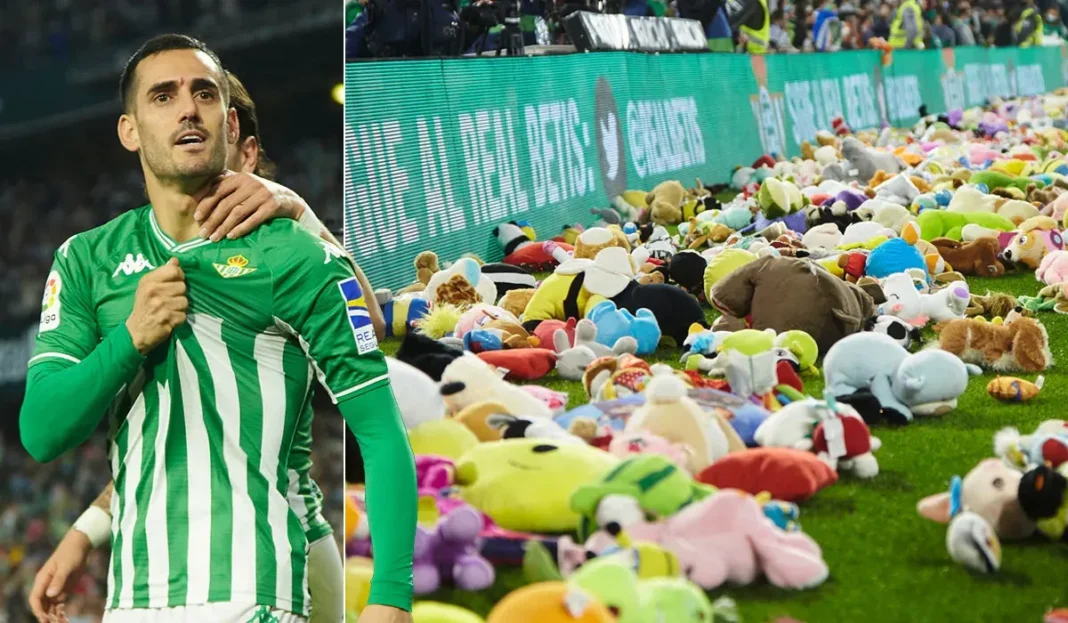

Every Christmas, Real Betis supporters transform the Benito Villamarín into a powerful scene of collective generosity. Fans rain thousands of stuffed toys onto the pitch at a pre-arranged moment, briefly pausing the match as the playing surface disappears beneath a wave of teddy bears and soft toys destined for children in need. Stewards, volunteers, and club staff quickly clear the field, allowing play to resume while the gifts begin their journey beyond the stadium.
The club then works closely with charities, community organisations, and NGOs to distribute the toys to underprivileged families in Seville, across Spain, and occasionally even further afield. Timed around Christmas and Día de Reyes, when gifts hold deep cultural meaning for children, the initiative ensures that joy reaches those who might otherwise go without. Over the years, the spectacle has drawn international attention through media coverage and social platforms, cementing its status as one of European football’s most admired feel-good traditions a vivid example of how a united fanbase can turn passion for the game into meaningful, lasting social impact.
How the tradition works:
Once a year, usually during Real Betis’ final home match before Christmas, the club invites supporters to take part in this unique act of generosity. Fans arrive at the Benito Villamarín carrying new or gently used stuffed toys, knowing they will soon become part of a moment that defines Betis’ festive spirit.
At a pre-announced moment most often at half-time the entire stadium acts in unison. Tens of thousands of supporters rise from their seats and launch the toys onto the pitch, triggering the famous lluvia de peluches , a breathtaking rain of teddy bears and soft animals that briefly transforms the grass into a sea of colour and goodwill.
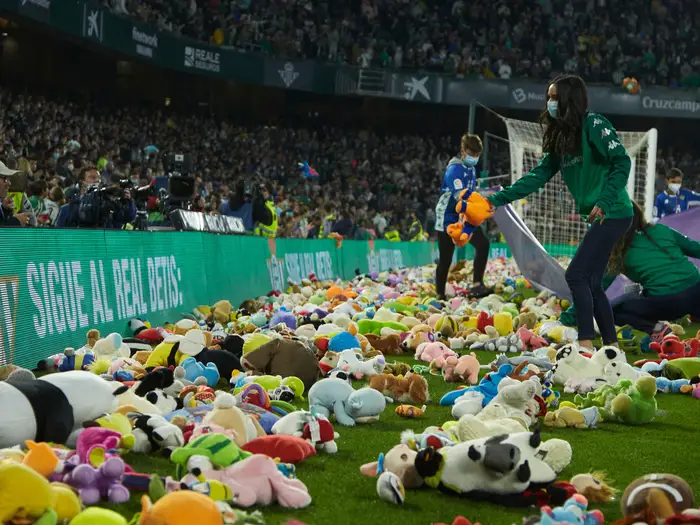
Stewards, club staff, and volunteers immediately spring into action. Working swiftly and efficiently, they clear the pitch so the second half can resume without disruption. In several editions, the number of donated toys has climbed to nearly 20,000, completely covering the playing surface, technical areas, and touchlines for a few unforgettable minutes, a powerful visual reminder of how collective fan action can turn a football match into a moment of shared humanity.
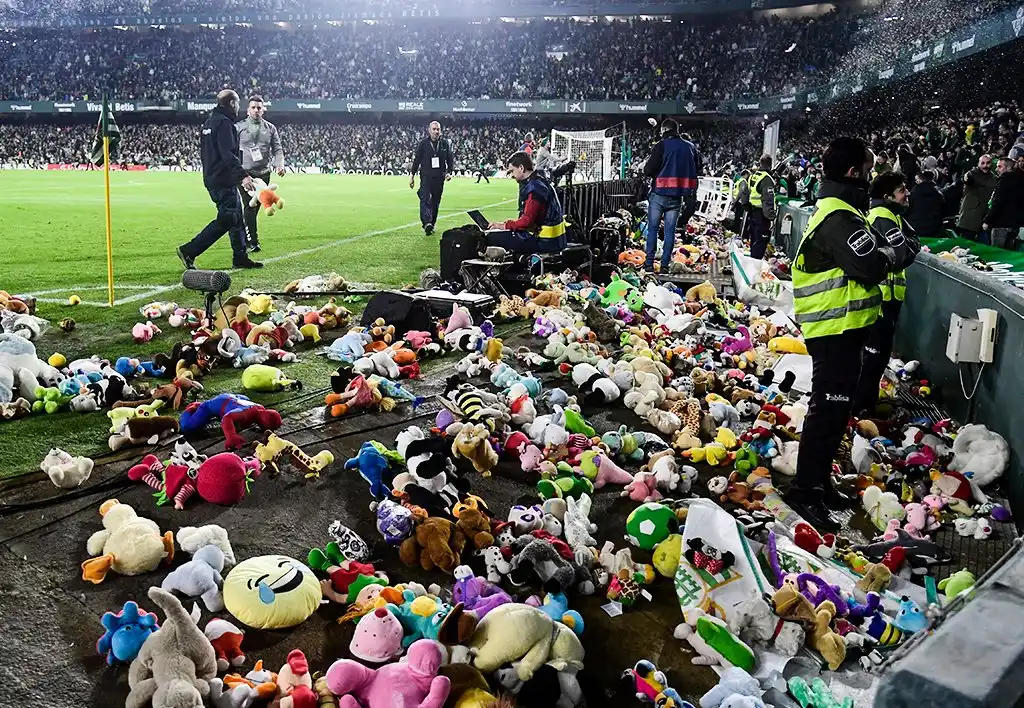
Purpose and beneficiaries:
Real Betis created this tradition with a clear and deeply human purpose: to make sure no child is left without a gift during the festive season. Once the toys are collected, the club actively partners with charities, local associations, and NGOs to organise their distribution. These organisations deliver the gifts to disadvantaged children and families in Seville, across Spain, and in some years even beyond national borders, extending the impact far beyond the stadium.
Betis and its supporters consistently present the initiative as “more than football.” Through this act, they place solidarity, community spirit, and social responsibility at the heart of the club’s identity. The gesture carries special weight in Spain, where Christmas and Día de Reyes (Three Kings’ Day) represent the most important moments of the year for children to receive presents. By stepping in during this period, Betis fans turn a matchday ritual into a meaningful guarantee of joy, dignity, and inclusion proving that a football club can serve as a powerful force for social good.
Origins and evolution:
Real Betis launched the toy-throwing initiative in the early 2010s as part of its wider Christmas charity programme, but the idea quickly outgrew its original scope. What began as a simple festive gesture soon turned into a permanent fixture on the Betis calendar, eagerly awaited by supporters every season. As images of the pitch buried under thousands of stuffed toys spread through viral videos, television coverage, and social media, the tradition gained international attention and established itself as one of the most distinctive supporter rituals in world football.
With popularity came structure and careful organisation. Each year, the club issues clear guidelines to supporters, specifying toy size limits (typically under 35 cm) and enforcing safety rules, such as avoiding batteries, hard plastic, or sharp components, to ensure every donation is safe and suitable for children of all ages. Stewards and volunteers receive advance coordination plans, and collection systems operate with near-military precision to minimise disruption to the match.
Crowds often fill the Benito Villamarín to near capacity for the occasion, and anticipation for the lluvia de peluches rivals excitement for the game itself. For many fans, the tradition has become an emotional highlight of the season, a moment when collective generosity takes centre stage and reinforces Real Betis’ reputation as a club where community and compassion matter as much as results on the pitch.
Why it resonates in football culture:
The Betis toy rain resonates so deeply in football culture because it transforms an ordinary league fixture into a shared act of generosity that everyone in the stadium participates in. In a matter of seconds, supporters visually remake the Benito Villamarín, turning a competitive arena into a powerful symbol of collective kindness. That striking contrast fierce competition one moment, overwhelming compassion the next gives the tradition an emotional weight that few matchday rituals can match.
Neutral fans, journalists, and broadcasters frequently describe the lluvia de peluches as one of the “best traditions in football.” They praise how it seamlessly blends crowd choreography, stadium atmosphere, and real charitable impact, proving that supporter culture can create moments just as memorable as goals or trophies. The spectacle’s visibility has also helped it travel beyond Seville, inspiring or reinforcing similar initiatives elsewhere, from teddy bear tosses in ice hockey to Christmas toy drives organised by clubs across different leagues and sports.
For Real Betis, the tradition goes even deeper. It strengthens the club’s identity as a community institution rooted in Seville rather than just a competitive entity. Supporters use the green and white not only to signal loyalty on matchday, but also to express empathy, solidarity, and inclusion. In doing so, Betis shows how football culture often defined by rivalry and results can also serve as a unifying force with the power to deliver genuine social good.